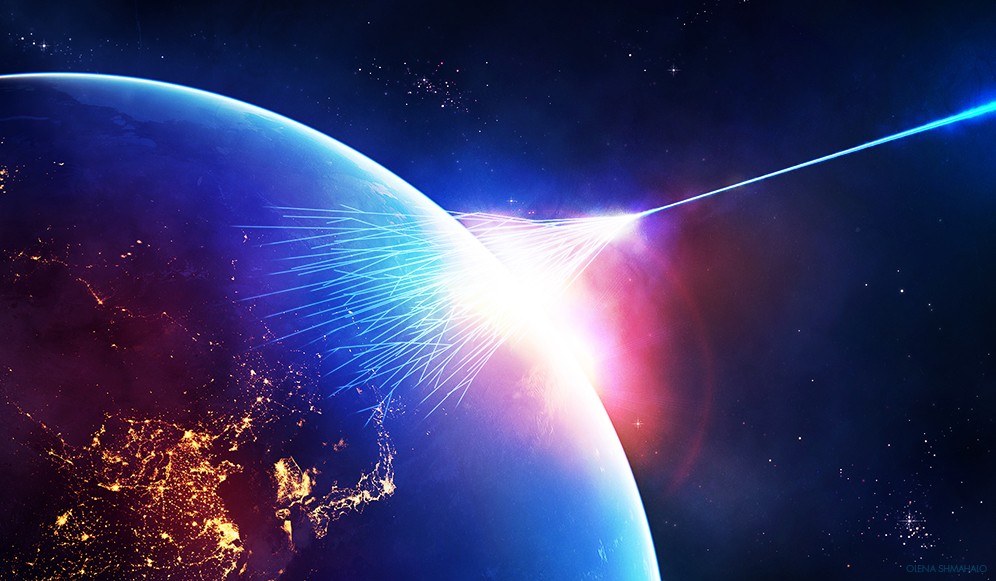
Binary neutron-star merger · 17 August 2017
GW170817
RA 197.45° · Dec -23.38°
Gravitational waves and light from the same neutron-star merger, the birth of multi-messenger astrophysics.
The full story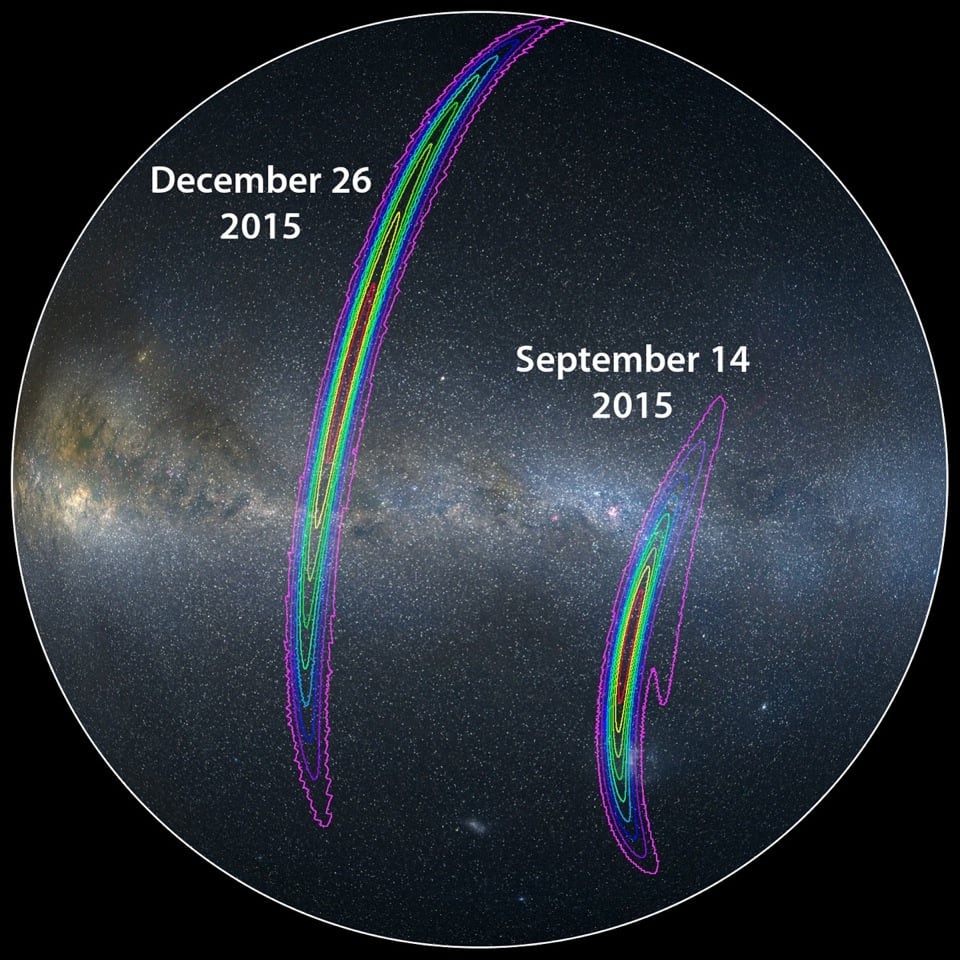
Landmark events
The multi-messenger milestones of the last decade and the group's part in each, on the sky and in time.
On the sky
Equatorial Aitoff map with the real positions of the events. Select a source to read what was seen.
Binary neutron-star merger · 17 August 2017
RA 197.45° · Dec -23.38°
Gravitational waves and light from the same neutron-star merger, the birth of multi-messenger astrophysics.
The full storyBlazar and neutrino source · 22 September 2017 · announced July 2018
RA 77.36° · Dec +5.69°
The high-energy neutrino IceCube-170922A arrived from the direction of a flaring gamma-ray blazar, the first evidence for a source of cosmic neutrinos.
The full storyGamma-ray burst · 20 July 2018
RA 0.53° · Dec -2.92°
The first detection of very-high-energy gamma rays from a gamma-ray burst, deep in its afterglow.
The full storyGamma-ray burst · 29 August 2019
RA 44.54° · Dec -8.96°
A nearby gamma-ray burst whose very-high-energy afterglow H.E.S.S. followed for several nights, with X-ray and TeV spectra that look strikingly alike.
The full storyMagnetar and fast radio burst · 27–28 April 2020
RA 293.73° · Dec +21.90°
A millisecond radio burst from the Galactic magnetar SGR J1935+2154, coinciding with an X-ray burst, gave the first direct link between fast radio bursts and magnetars.
The full storyRecurrent nova · August 2021
RA 267.55° · Dec -6.71°
The 2021 eruption of the recurrent nova RS Ophiuchi became the first Galactic transient detected at very high energies.
The full storyGamma-ray burst · 9 October 2022
RA 288.26° · Dec +19.77°
The brightest gamma-ray burst ever recorded, nicknamed the BOAT. H.E.S.S. limits help constrain how its afterglow produced high-energy photons.
The full storyIn time
Cosmic-ray energy spectrum
The first precise measurement of the energy spectrum of ultra-high-energy cosmic rays from hybrid events, seen at the same time by the fluorescence and surface detectors of the Pierre Auger Observatory.
Our part · The main result of Fabian's PhD thesis at the Universität Karlsruhe, published by the Pierre Auger Collaboration in Physics Letters B.
The full storyBinary neutron-star merger
Gravitational waves and light from the same neutron-star merger, the birth of multi-messenger astrophysics.
Our part · Fabian and his PhD student Monica Seglar-Arroyo selected the H.E.S.S. pointings. Observations were requested five minutes after LIGO/Virgo published the localisation and started the same evening.
The full storyBlazar and neutrino source
The high-energy neutrino IceCube-170922A arrived from the direction of a flaring gamma-ray blazar, the first evidence for a source of cosmic neutrinos.
Our part · The alert met the criteria of the H.E.S.S. neutrino follow-up programme Fabian had set up, and H.E.S.S. took part in the worldwide observing campaign.
The full storyGamma-ray burst
The first detection of very-high-energy gamma rays from a gamma-ray burst, deep in its afterglow.
Our part · Fabian convenes the H.E.S.S. transients working group, which runs the GRB observation programme. He was not part of the analysis of this burst.
The full storyGamma-ray burst
A nearby gamma-ray burst whose very-high-energy afterglow H.E.S.S. followed for several nights, with X-ray and TeV spectra that look strikingly alike.
Our part · Fabian drafted the first GCN circular and Astronomer's Telegram and led one of the two independent H.E.S.S. analyses.
The full storyMagnetar and fast radio burst
A millisecond radio burst from the Galactic magnetar SGR J1935+2154, coinciding with an X-ray burst, gave the first direct link between fast radio bursts and magnetars.
Our part · H.E.S.S. observed the magnetar during its burst storm through its follow-up programme for soft gamma repeaters. Fabian co-wrote the H.E.S.S. Source of the Month on these observations; the results were published in ApJ in 2021.
The full storyRecurrent nova
The 2021 eruption of the recurrent nova RS Ophiuchi became the first Galactic transient detected at very high energies.
Our part · Observed and announced within the H.E.S.S. transients programme.
The full storyGamma-ray burst
The brightest gamma-ray burst ever recorded, nicknamed the BOAT. H.E.S.S. limits help constrain how its afterglow produced high-energy photons.
Our part · H.E.S.S. follow-up campaign over more than a week; the very-high-energy upper limits were published in ApJ Letters.
The full storyJoint follow-up campaign
Four Cherenkov telescope arrays, Fermi-LAT and IceCube combined their follow-up of IceCube neutrino alerts into one legacy dataset covering the whole sky.
Our part · Fabian led the project on behalf of the H.E.S.S. collaboration.
The full story