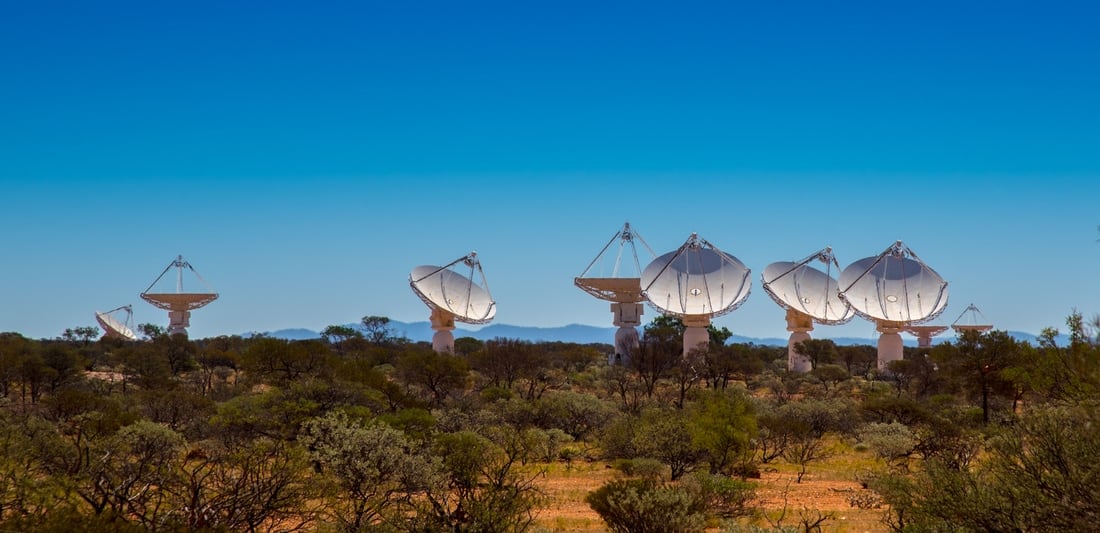
FRB 150418 · Parkes, ATCA, H.E.S.S.
The first TeV limits on a fast radio burst
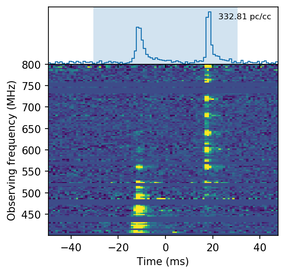
On 18 April 2015 the SUPERB team detected FRB 150418 at the Parkes telescope, in real time. The ATCA array then found a radio afterglow in the direction of the burst, lasting up to six days, and optical follow-up linked it to an elliptical galaxy at z = 0.492 (WISE J071634.59-190039.2). Had it held, this would have been the first identified host galaxy of a fast radio burst; renewed radio activity from the region almost a year later raised doubts about the connection.
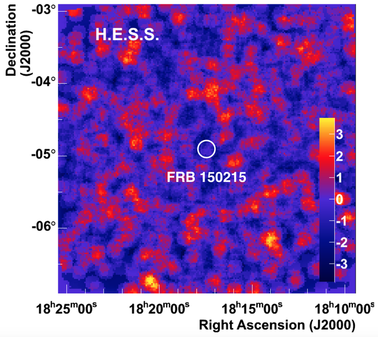
H.E.S.S. observed the field about 14.5 hours after the burst, as soon as the sky was dark enough. The 1.4 hours of data show no gamma-ray afterglow; assuming a generic E⁻² spectrum, the upper limit above 350 GeV is 1.33 × 10⁻⁸ m⁻² s⁻¹ (99% C.L.). These were the first limits ever placed on the TeV afterglow of a fast radio burst, and I summarised them in the H.E.S.S. and SUPERB paper below.
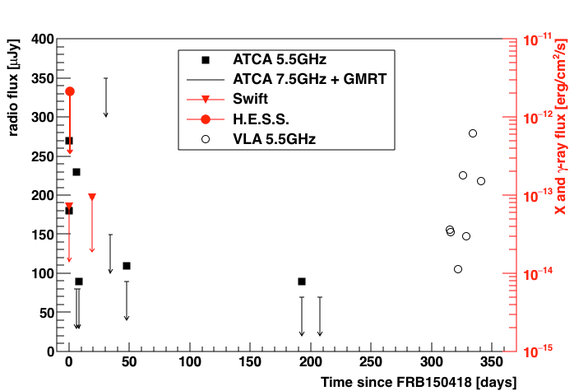
First limits on the very-high energy gamma-ray afterglow emission of a fast radio burst: H.E.S.S. observations of FRB 150418
H.E.S.S., SUPERB · 2017 · Astron.Astrophys. 597 A115
Limits on the TeV gamma-ray afterglow of fast radio bursts with H.E.S.S.
H.E.S.S., SUPERB · 2017 · AIP Conf.Proc. 1792 060013