
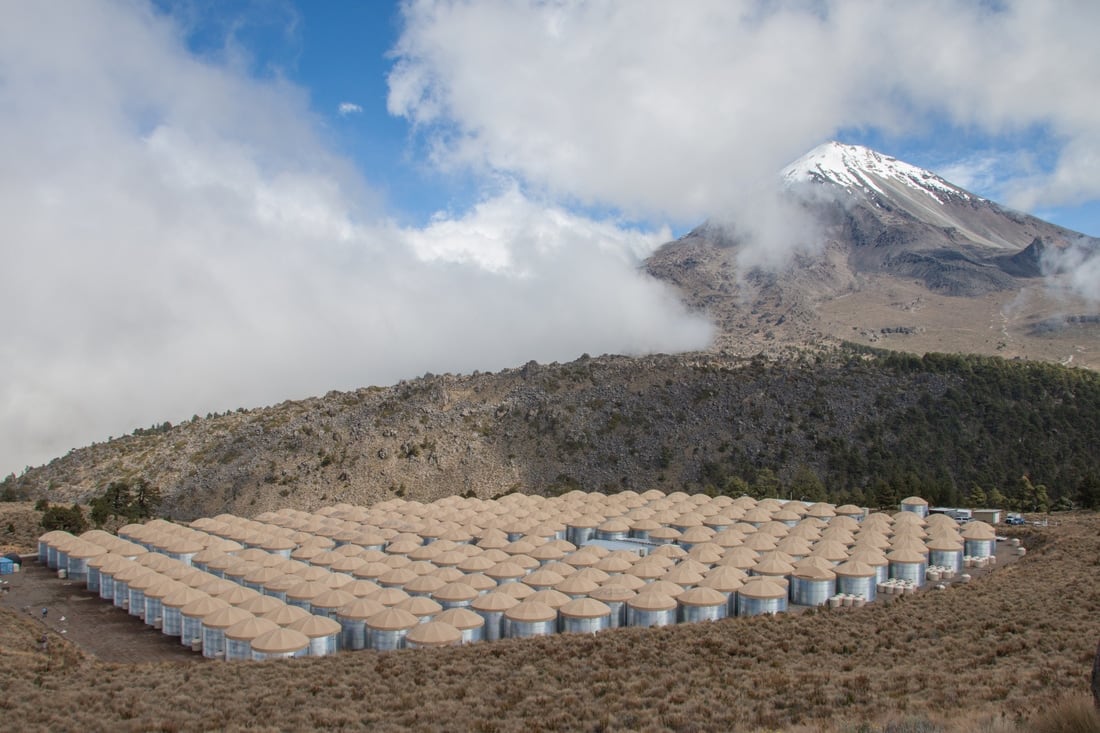
The water-Cherenkov tanks of the HAWC observatory below the Pico de Orizaba volcano in Mexico

Research area

SGSO + AMIGO

AMIGO explored a detector concept using reused ANTARES optical modules, which led to the creation of the SGSO alliance which laid the groundwork for a wide-field gamma-ray observatory in the Southern Hemisphere, now called SWGO

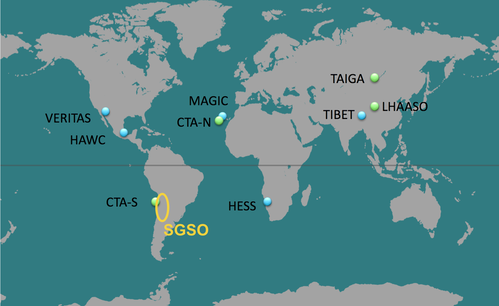
Following the success of the HAWC observatory in Mexico, work started towards a next-generation gamma-ray observatory in the Southern Hemisphere. Just as CTA improves on the current Cherenkov telescopes (H.E.S.S., VERITAS and MAGIC), a new large field-of-view observatory should match the sensitivity and directionality of CTA. It would monitor the very-high-energy sky and trigger deep CTA follow-up of interesting events such as AGN flares, binary outbursts and new transients, increasing the science output of both observatories.

SGSO alliance · 2017–2019

Towards a southern wide-field observatory

Several design options were studied in parallel, with the common goal of forming an international collaboration to drive the project. As a first step, we set out the science case of the new instrument, for example in PoS(ICRC2017)851, and worked towards selecting a site, most probably in the Andes. The Southern Gamma-ray Survey Observatory (SGSO) alliance was founded at the end of 2017 to advance the design, funding and eventual construction of such an observatory. I led the alliance until it converged into the SWGO collaboration, established in 2019.
AMIGO proposal · 2016

A second life for the ANTARES optical modules

I also led the AMIGO proposal (ANTARES Modules in a Gamma-ray Observatory), which aimed to recover the optical modules of the ANTARES deep-sea neutrino telescope at the end of its data taking and use them in water-Cherenkov tanks of the new gamma-ray observatory. The proposal was supported by 45 scientists from 20 institutes in seven countries, but was not followed up by the ANTARES collaboration.

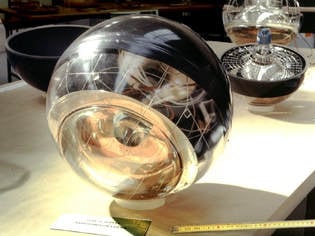
ANTARES detected Cherenkov light with 885 optical modules, immersed between 2006 and 2008 at depths beyond 2000 m and a constant temperature of 13.3 °C; after 8 to 10 years of operation, a large fraction of them still worked. Each module is a pressure-resistant glass sphere, 17 inches in diameter and qualified up to 700 bar, housing a photomultiplier and its active base, which provides the high voltage, slow control and readout of the signal.

An ANTARES optical module, a glass sphere housing a photomultiplier

CTA electronics

Reading out the tanks

The readout and trigger electronics of a water-Cherenkov array have much in common with the cameras of Cherenkov telescopes, and CTA development has made high-performance, cost-efficient electronics available. Two options were studied:

  • FlashCAM-based electronics. HAWC uses the readout and trigger electronics developed for FlashCAM, a camera proposed for the CTA medium-size telescopes, in its high-energy extension: 350 small water-Cherenkov tanks of 2500 litres each, spaced 15 m apart around the main array, each with an 8-inch photomultiplier. First test-bench measurements showed that ANTARES modules can be read out with this electronics.
  • NectarCAM-based electronics. The Nectar chip, which builds on the ARS chip used in ANTARES, has an analogue memory of 1024 cells and digitises the signal with 12-bit accuracy only when a trigger arrives, sending it to a node for event building. This would reduce the data bandwidth between the tanks and the nodes compared with digitising every signal locally. The chip is used in the upgraded H.E.S.S. cameras and in the NectarCAM camera for CTA.