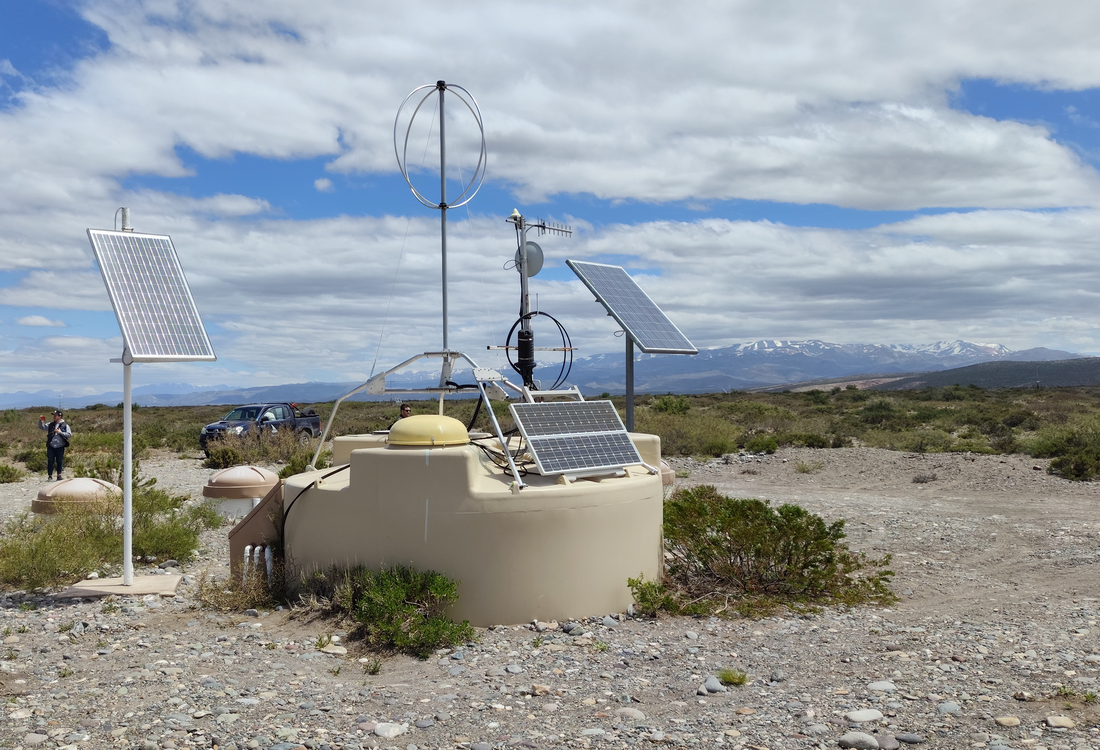
A surface detector station of the Pierre Auger Observatory in front of the Andes

Research area

Cosmic rays

Cosmic rays reach energies far beyond those produced by human-made accelerators. Work with the Pierre Auger Observatory investigates their spectrum, composition and origins.

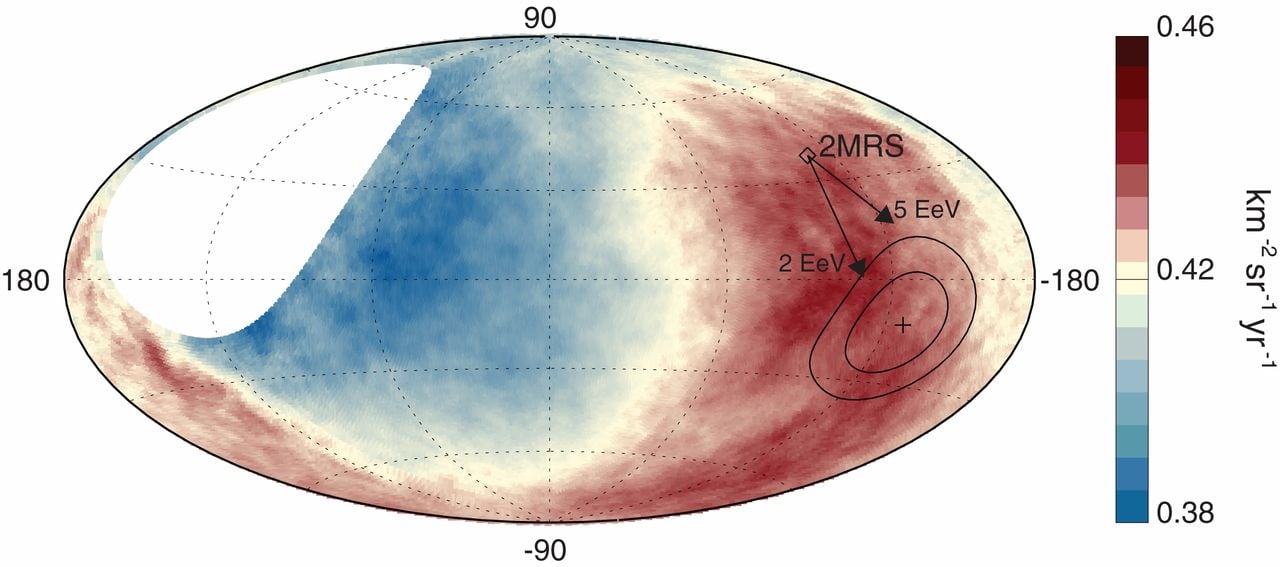
Cosmic rays are protons and heavier nuclei accelerated in astrophysical sources to tremendous energies, far beyond man-made accelerators such as the LHC. When they hit the Earth’s atmosphere, they start cascades of secondary particles, extensive air showers, which can be detected by particle detectors on the ground or by fluorescence telescopes watching the atmosphere. The Pierre Auger Observatory, the largest cosmic-ray detector in the world, combines both in a hybrid design.

I started my scientific career studying ultra-high-energy cosmic rays with the Pierre Auger Observatory, and the search for their sources remains one of the main driving forces behind my research.

Diploma thesis · 2005

Reconstructing air showers

During my diploma thesis I introduced a new technique to reconstruct extensive air showers, presented at the 29th ICRC in 2005. It received the 2005 Edison Award of the General Electric Foundation and the Helmholtz young scientist award for the best German diploma thesis in astroparticle physics.
Pierre Auger Observatory · 2007

Cosmic rays and active galactic nuclei

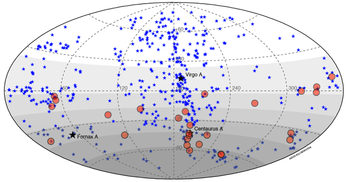
During my PhD I worked on a cross-check analysis of the search for correlations between the highest-energy cosmic rays and active galactic nuclei, published in Science in 2007. The correlation was very intriguing at the time, but it has not been strengthened by the data collected since.

Sky map of the arrival directions of ultra-high-energy cosmic rays and the positions of nearby active galactic nuclei
Arrival directions of ultra-high-energy cosmic rays detected by the Pierre Auger Observatory (red circles) and positions of active galactic nuclei (blue stars). From R. Engel and F. Schüssler, Spektrum der Wissenschaft, 01/2008.

PhD thesis · 2010

The first hybrid energy spectrum

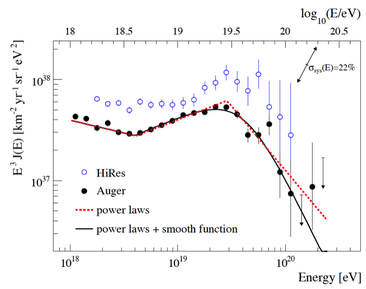
I also developed the tools to determine the exposure of the Pierre Auger Observatory's hybrid detector, including RealMC, a time-dependent Monte Carlo scheme that reproduces the exact data-taking conditions of the full observatory, all of its subsystems and the changing atmosphere. With these methods I derived the first energy spectrum of ultra-high-energy cosmic rays from hybrid events, which combine the observatory's two detector types. The spectrum shows the ankle at about 1018.6 eV and a strong suppression of the flux above about 1019.5 eV. More details are in my PhD thesis.

Energy spectrum of ultra-high-energy cosmic rays measured by the Pierre Auger Observatory
The energy spectrum of ultra-high-energy cosmic rays measured by the Pierre Auger Observatory, the main result of my PhD thesis.