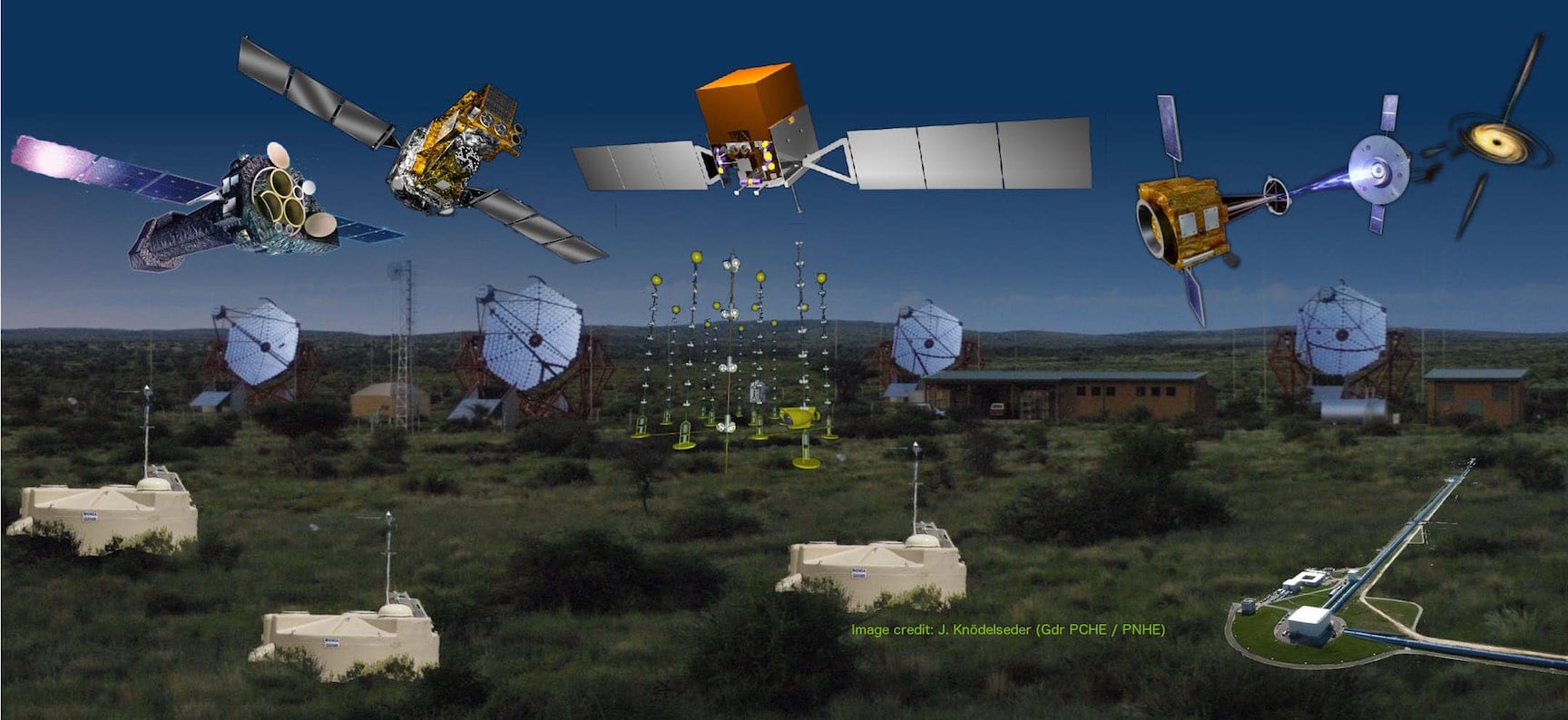
High-energy observatories on the ground and in space studying the multi-messenger sky

Research area

Astro-COLIBRI

Astro-COLIBRI brings alerts, observations and contextual information from across the multi-messenger sky into one real-time platform for professionals and amateurs.

The worldwide network of multi-messenger observatories produces a wealth of information, and catching the most violent explosions in the universe means reacting in real time. Astro-COLIBRI is the platform we developed for this: it evaluates alerts on transient events in real time, filters them by criteria set by each user, and places them in their multi-wavelength and multi-messenger context. By quickly giving an overview of persistent sources and transient events in the relevant phase space, it increases the discovery potential of both serendipitous and follow-up observations.

Architecture

One platform for the transient sky

Astro-COLIBRI combines an application programming interface (API), a static and a real-time database, a cloud-based alert system, and a website and apps for iOS and Android. The clients show a graphical summary of the relevant data so that interesting phenomena can be identified quickly, together with an assessment of the observing conditions at a large selection of observatories around the world. With direct access to many external services, Astro-COLIBRI is a central point for information about astrophysical sources and transient events.

To meet the needs of real-time observations, the clients are built with the open-source framework Flutter, which provides the same interface on every platform, including mobile devices.
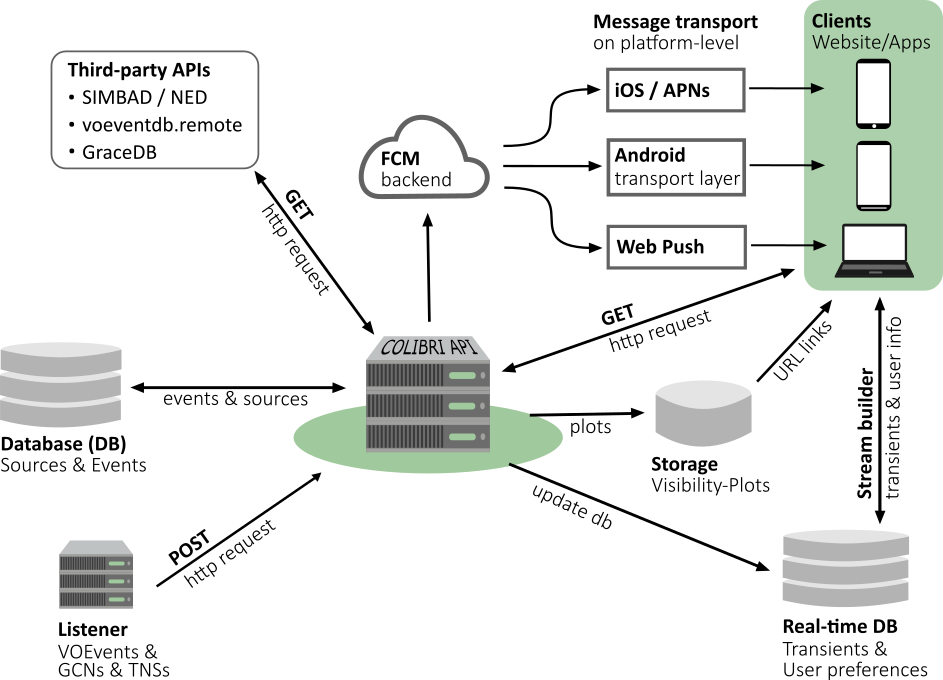
Architecture of Astro-COLIBRI, with databases and alert services around the central COLIBRI API, which serves the website and the apps

Context and visibility

Every event in context

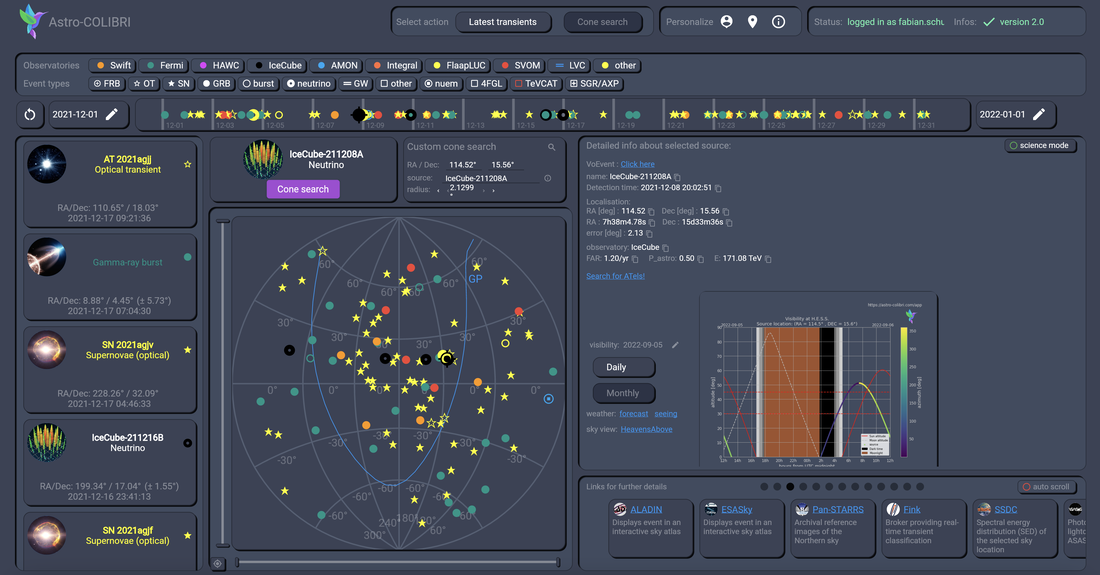
Astro-COLIBRI shows each event against historical data and other transients, on the timescale relevant for its category. A cone search around the event lists known sources and recent transients, and the localisation uncertainty is drawn on the sky.

Coordinating follow-up observations also means knowing who can observe what, and when. Astro-COLIBRI shows the short- and long-term visibility of events from all major observatories or any custom location: source altitude, Sun and Moon altitude, Moon phase and Moon–source separation. Exact observing conditions, including observations under moonlight, are implemented for selected observatories, and a link to ESA's TOBY tool gives the visibility and schedule of space observatories such as INTEGRAL, Gaia, Chandra, Insight-HXMT, XMM-Newton and Swift.

The Astro-COLIBRI 2.0 web interface with a sky map, a list of transient events and the details of the selected event

Free for everyone

Used by professionals and amateurs

Astro-COLIBRI is free for professional and amateur astronomers, and burst advocates at several observatories (H.E.S.S., the LST-1 telescope of CTAO, SVOM and others) use it regularly. Version 2.0 of the web interface, released in August 2022, is described in the Galaxies paper; examples of use are given in F. Schüssler et al., PoS(ICRC2021) 935.

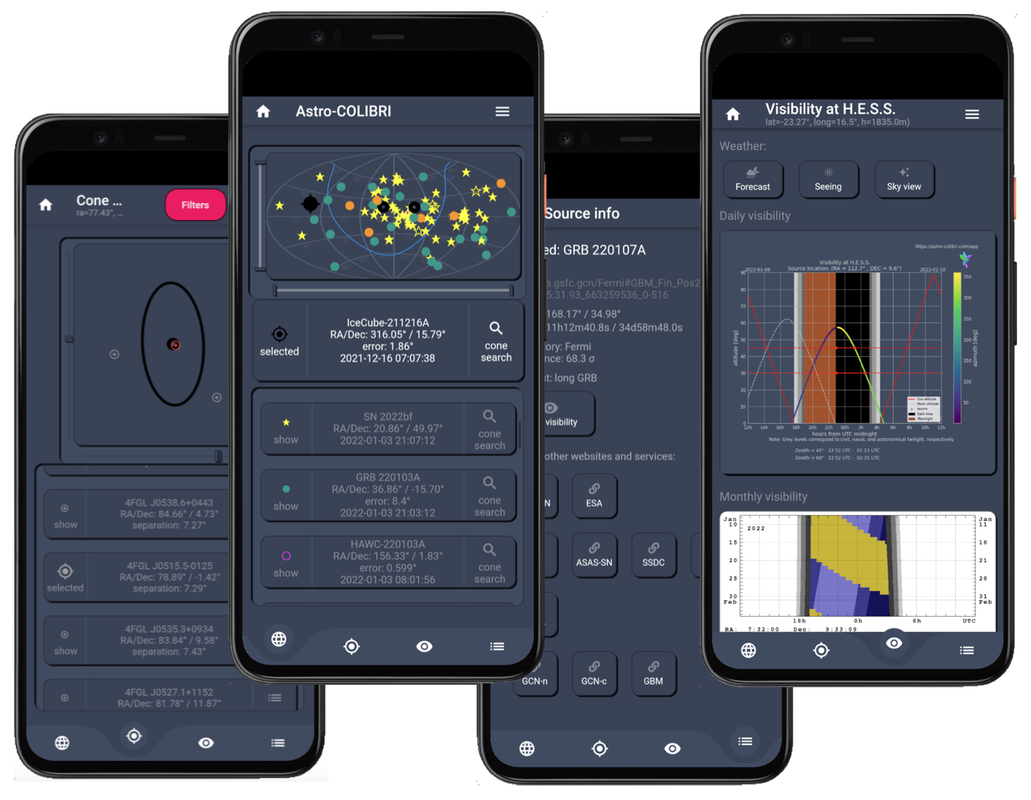
The website is at astro-colibri.com, and the apps are on Google Play and the App Store. Tutorials are on our YouTube channel, and discussions take place on the forum.

Overview of the Astro-COLIBRI 2.0 mobile app screens

New in 2026

The transient sky in augmented reality

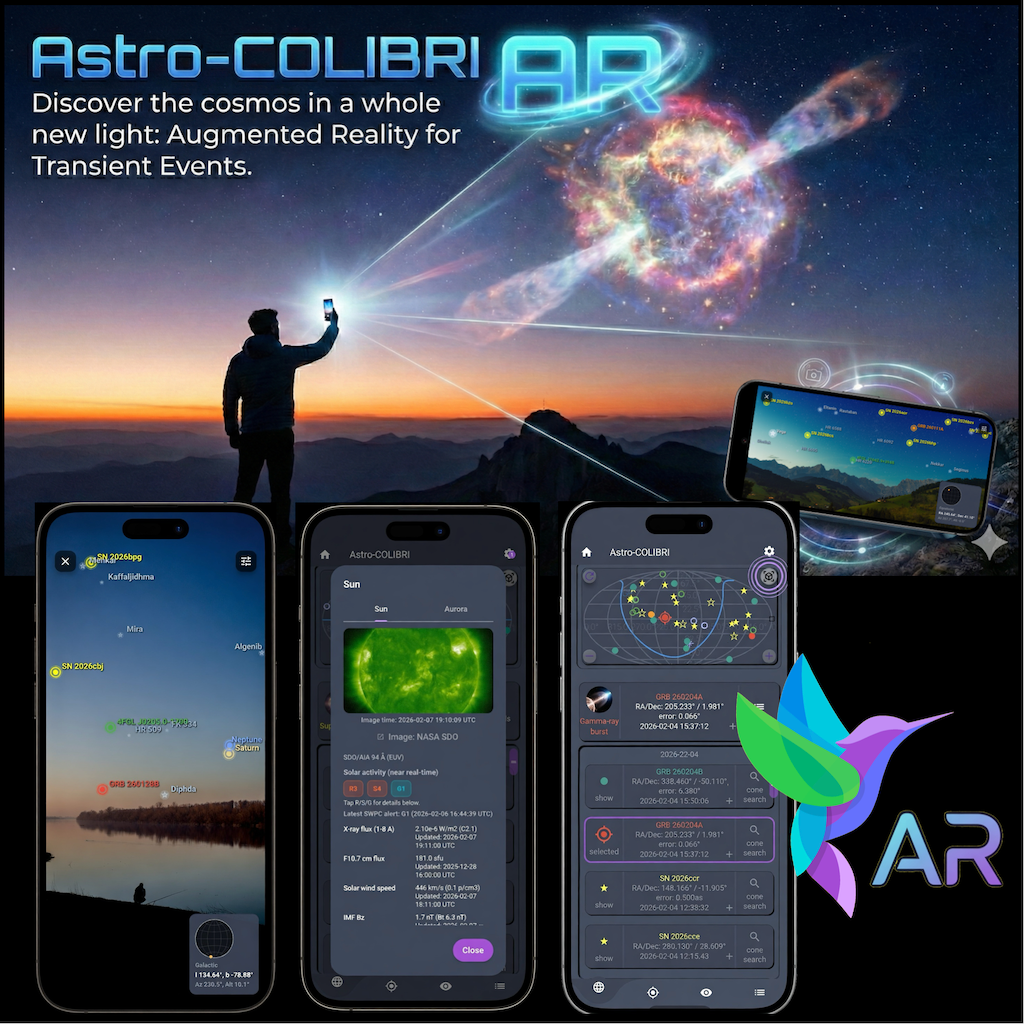
In early 2026 we added a fundamentally new interface to Astro-COLIBRI: the transient sky can now be explored in augmented reality, overlaid on the real sky through the camera of a phone.

Astro-COLIBRI AR, a person holding up a phone towards the evening sky, with app screens showing transient events overlaid on the sky