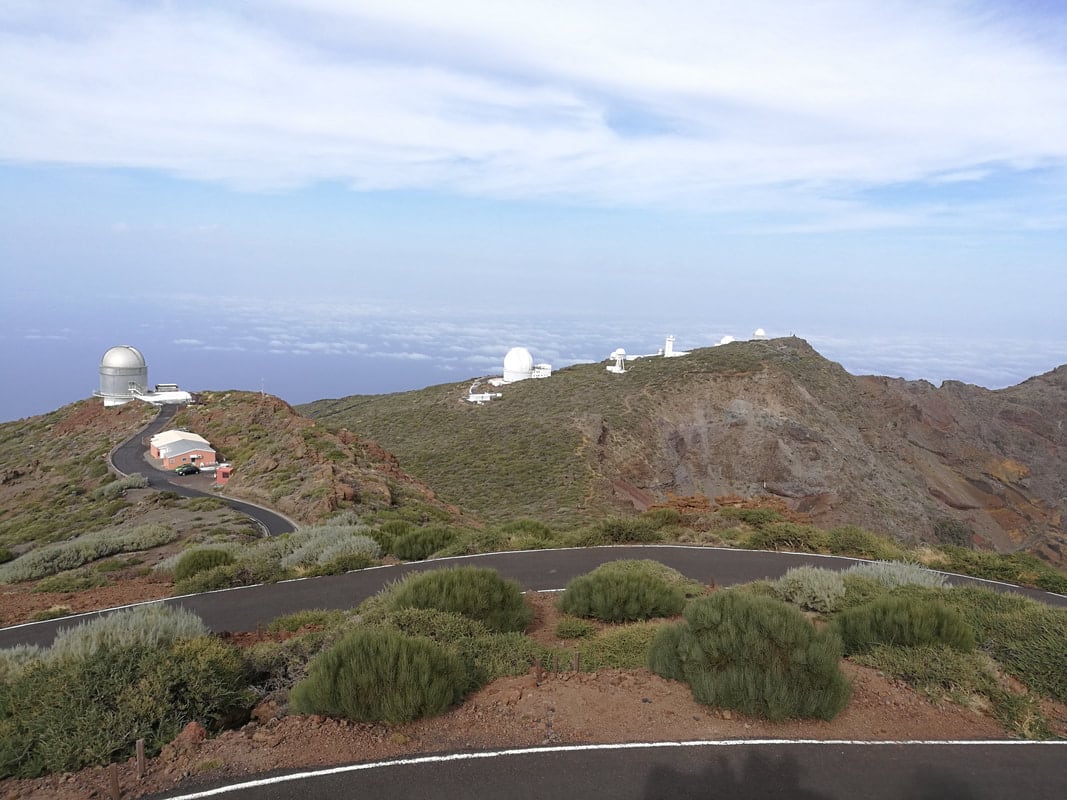
Telescopes of the Roque de los Muchachos Observatory on La Palma

Research area

Gamma-ray astronomy

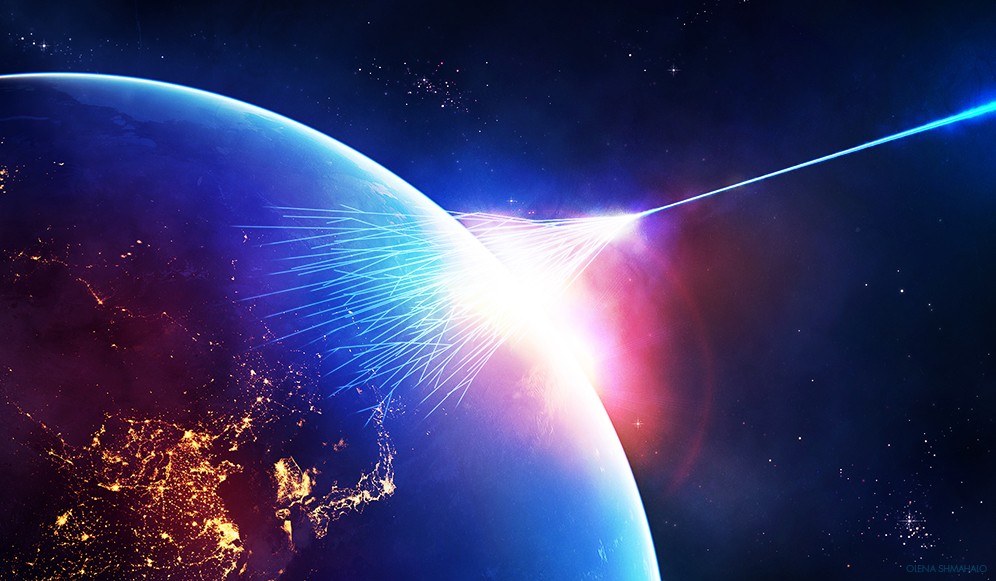
Very-high-energy gamma rays reveal extreme particle acceleration. This page presents research with H.E.S.S., CTAO and related observatories.

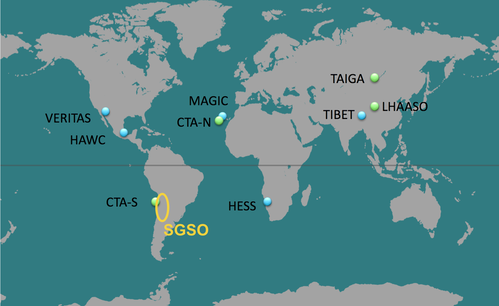
Very-high-energy gamma rays reveal where particles are accelerated to extreme energies. I work with the imaging atmospheric Cherenkov telescopes of H.E.S.S., prepare the science of the upcoming Cherenkov Telescope Array Observatory, and have helped shape the next wide-field gamma-ray observatory in the Southern Hemisphere.

H.E.S.S. · since 2012

The High Energy Stereoscopic System

I joined H.E.S.S. in 2012 to broaden my work on multi-messenger analyses, and presented a first joint neutrino and gamma-ray analysis on behalf of the collaboration at the 33rd ICRC in 2013 (arXiv:1307.6074). Besides contributions to the data calibration, I was the corresponding author of the paper on simultaneous H.E.S.S. and RXTE observations of microquasars, and analysed the first H.E.S.S. follow-up of fast radio bursts.

I established and led several topical tasks within H.E.S.S. ("Neutrino alert system", "High-energy neutrino events" and "Gravitational waves"), and in 2014 I was named the official H.E.S.S. multi-messenger contact. Since 2019 I have led the H.E.S.S. transients programme, which takes an increasing share of the total observing time, from gamma-ray bursts to neutrino and gravitational-wave alerts.

RS Ophiuchi · SN 2024ggi

Explosions in and near the Milky Way

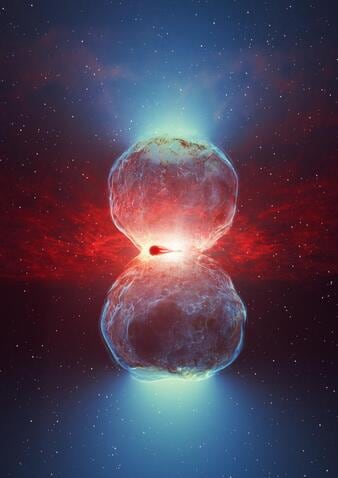
In August 2021 the recurrent nova RS Ophiuchi became the first Galactic transient detected at very high energies. H.E.S.S. observed gamma rays up to a month after the outburst; their time profile follows the GeV emission with a two-day delay in the peak, which favours a hadronic origin. Shocks in dense winds are therefore good places to accelerate cosmic rays to very high energies.

Supernovae exploding into a dense circumstellar medium could be even more powerful accelerators. H.E.S.S. observed SN 2024ggi in NGC 3621, 7.24 Mpc away, for 30 hours over the month after the explosion. The upper limits exclude bright gamma-ray emission in the first day, and the later limits are consistent with the wind densities derived from optical observations.

Artist's impression of the RS Ophiuchi binary system, a white dwarf accreting matter from a red giant companion

CTAO

The Cherenkov Telescope Array Observatory

Within the CTAO consortium I mainly work on preparing the scientific exploitation. I was a member of the core editorial board of the CTAO Key Science Project on transient sources, focusing on multi-messenger aspects such as how CTAO responds to alerts from neutrino telescopes and gravitational-wave observatories, and I put together the top-level science use cases that define this response. In 2018 and 2019 I convened the "Transients and MWL" science working group. The scheduling tools we develop for H.E.S.S. now prepare CTAO's gravitational-wave follow-up.

HAWC · SGSO · SWGO

Wide-field gamma-ray observatories

Air-shower arrays monitor the gamma-ray sky with particle detectors on the ground, a technique largely complementary to Cherenkov telescopes such as H.E.S.S. and CTAO. I became an associated member of the HAWC collaboration in 2017, contributing to multi-messenger analyses. Following HAWC's success, we started the Southern Gamma-ray Survey Observatory (SGSO) alliance to define and promote a similar observatory in the Southern Hemisphere; it has since become a full scientific collaboration, SWGO.