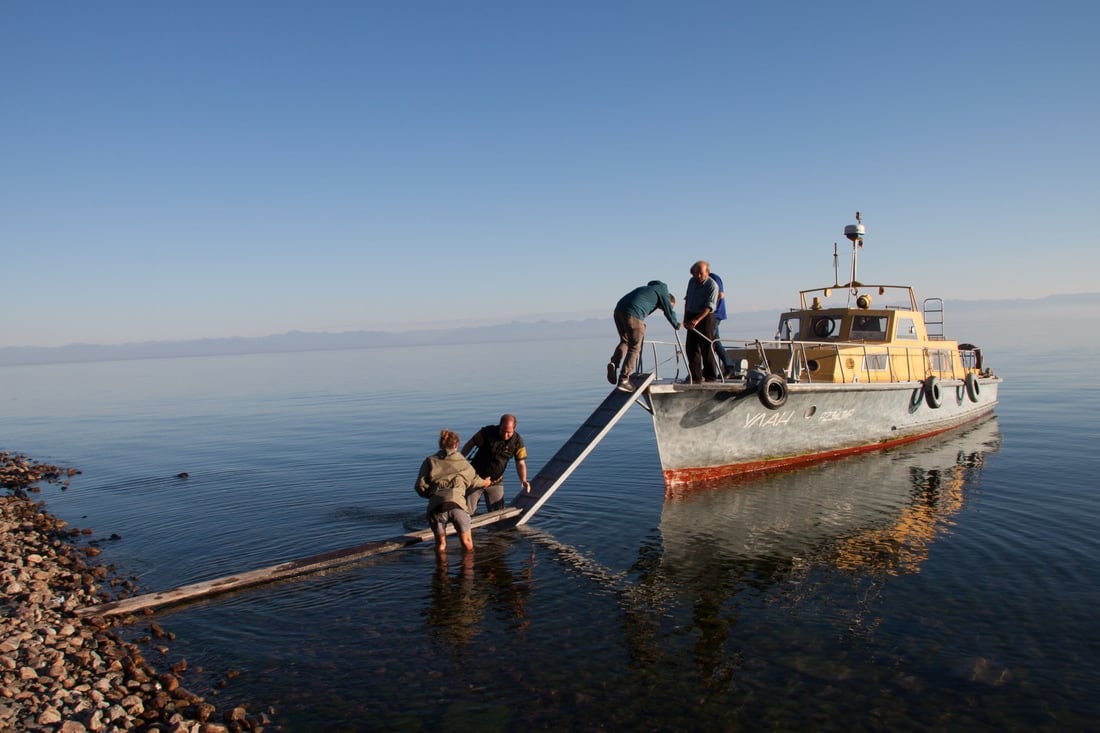
Lake Baikal, home of the Baikal neutrino telescope

Research area

Neutrino astronomy

Neutrinos point back to otherwise hidden cosmic accelerators. Searches with ANTARES, IceCube and gamma-ray observatories help trace their astrophysical origins.

Neutrinos point back to cosmic accelerators that may be hidden at other wavelengths. I have been a member of the ANTARES collaboration, which operated a neutrino telescope in the Mediterranean Sea, since 2009, and I combine neutrino data with gamma-ray observations to search for their sources, from ANTARES sky maps to real-time follow-up of IceCube alerts.

ANTARES · 2010–2014

Searching for clusters in the neutrino sky

In 2010 I obtained a three-year Marie Curie fellowship through the COFUND action "EuroTalents" for a research project on searches for sources of astrophysical neutrinos with ANTARES. Its main result is an improved method to search for clusters in sky maps, based on the auto-correlation of individual events. Applied to the ANTARES high-energy neutrino data, together with cross-correlations with other messengers and source candidates (high-energy gamma-ray sources, massive black holes and nearby galaxies), it found no significant deviation from the isotropic distribution expected from atmospheric backgrounds.

ANTARES · TAToO

Neutrino alerts for telescopes

Within the TAToO sub-collaboration I helped develop and commission an online alert system that connects ANTARES to networks of robotic optical telescopes, the Swift X-ray satellite and the H.E.S.S. gamma-ray observatory. A fast online reconstruction of muon tracks triggers the follow-up for special events, such as two or more neutrinos coincident in time and direction, or a single neutrino of very high energy.

IceCube · H.E.S.S. and partners

Real-time follow-up of IceCube neutrinos

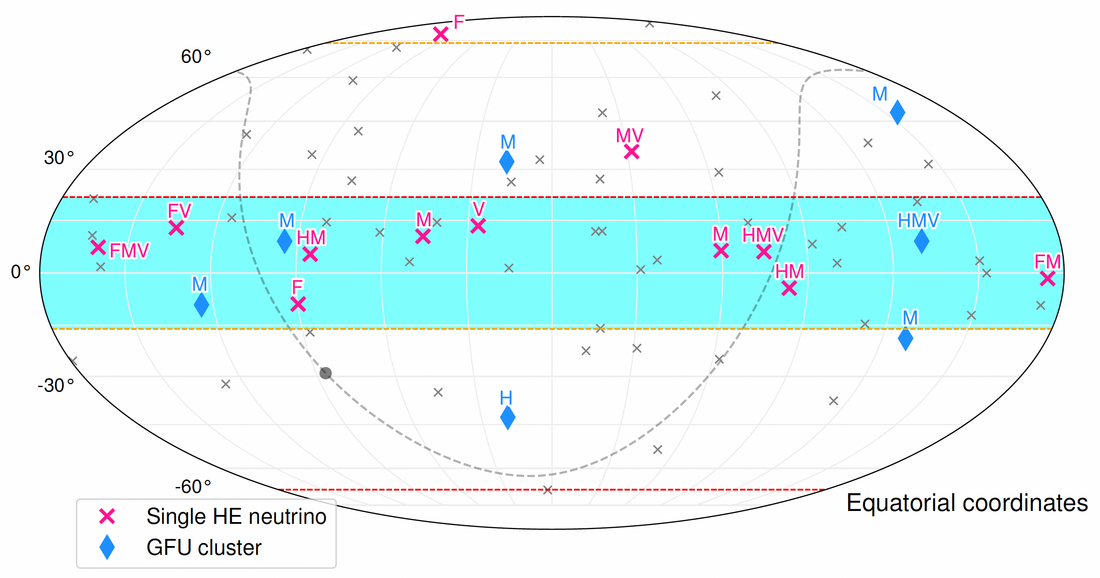
Since the neutrino IceCube-170922A pointed to the flaring blazar TXS 0506+056, the Cherenkov telescopes FACT, H.E.S.S., MAGIC and VERITAS have been following IceCube alerts: single astrophysical neutrino candidates, and known gamma-ray sources after IceCube identifies a cluster of neutrino events. I led, on behalf of H.E.S.S., the joint analysis of these programmes from September 2017 to January 2021, combined with Fermi-LAT and IceCube into one legacy data set.

Individual alerts can trigger large campaigns. The blazar PKS 0735+178, 2.2° from the neutrino IceCube-211208A, was in a high state from the optical to GeV gamma rays at the time of the neutrino; the gamma-ray data from Fermi-LAT, VERITAS and H.E.S.S. require a spectral cutoff near 100 GeV, which strongly constrains both leptonic and hadronic models.

Sky map in equatorial coordinates of IceCube neutrino alerts from 2017 to 2021, with those followed up by the Cherenkov telescopes in colour

ANTARES · since 2009

Inside the collaboration

I developed an energy reconstruction algorithm and a data format for physics analysis that became the standard within ANTARES. In 2010 I was appointed convener of the working group "Analysis Tools: Software and Reconstruction" and thereby became a member of the ANTARES Steering Committee. I have also served as internal referee for several physics papers and was a nominated member of the Publication Board from 2012 to 2016.