Research programme
Research
Explore how gamma rays, neutrinos, cosmic rays and gravitational waves are combined to investigate the most energetic sources and transients in the universe.
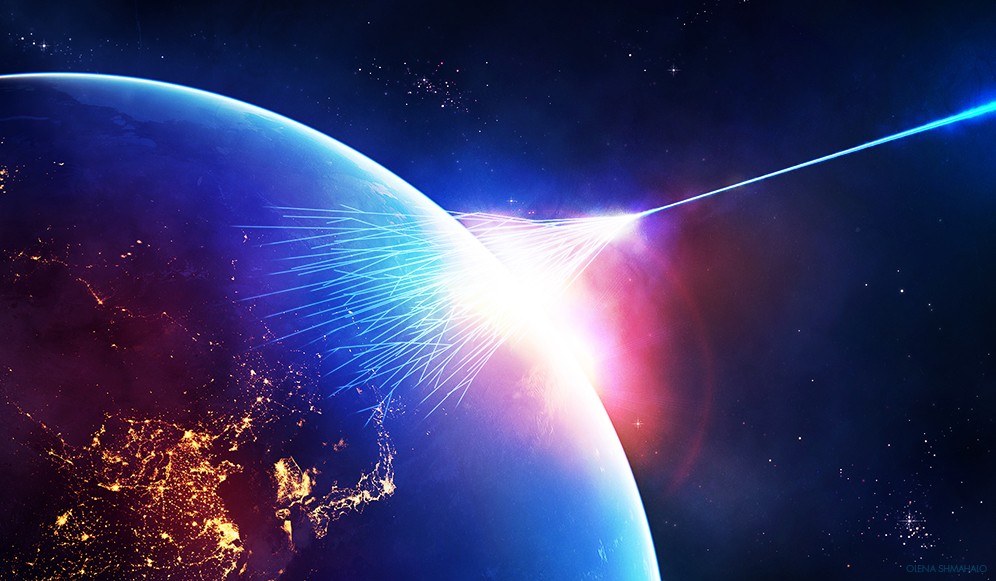
In the most general terms, I am searching for the origin of cosmic rays. These particles hit the Earth’s atmosphere with energies orders of magnitude above those achieved in man-made accelerators. More than 100 years after their discovery, their origin remains unclear, and I am trying to add small pieces to the eventual solution of this puzzle.
Instruments and collaborations
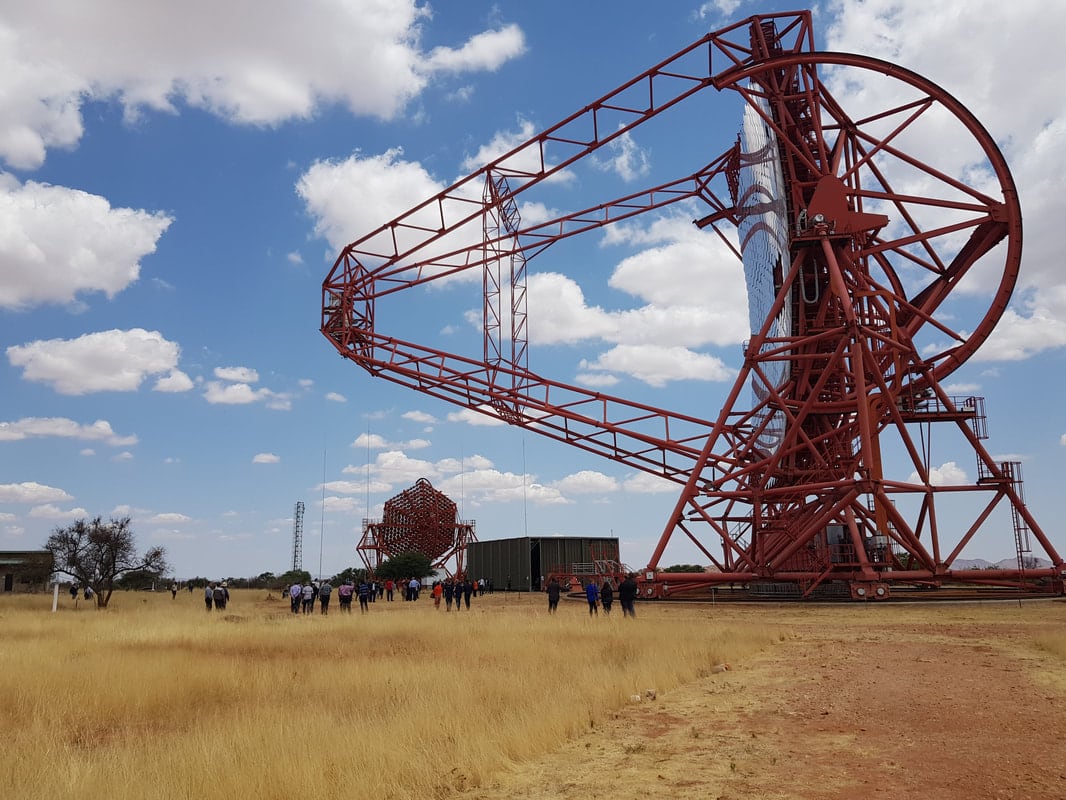
- H.E.S.S.: the array of imaging air Cherenkov telescopes on the Khomas highlands in Namibia, where I spent most of my research time. Its four 12 m telescopes are complemented by HESS-II, a single telescope with a 28 m mirror. Gamma-ray astronomy →
- CTAO: the next-generation Cherenkov telescope array on two sites, one per hemisphere, roughly ten times more sensitive than current instruments. Gamma-ray bursts →
- SWGO (formerly SGSO): a future wide-field water-Cherenkov observatory in the Southern hemisphere, following the HAWC concept. SGSO + AMIGO →
- IceCube and ANTARES: neutrino telescopes with real-time alert systems, which make joint neutrino and gamma-ray searches possible. Neutrino astronomy →
- Pierre Auger Observatory: where I started my career, studying ultra-high-energy cosmic rays during my diploma and PhD theses. Cosmic rays →
These instruments are tied together in real time by Astro-COLIBRI, tilepy and the MOTS project.
Explore
Research areas.
01Real-time platforms
Astro-COLIBRI
Astro-COLIBRI brings alerts, observations and contextual information from across the multi-messenger sky into one real-time platform for professionals and amateurs.
MOTS
MOTS is an ANR-funded collaboration developing rapid, coordinated observations of the transient sky across multiple observatories and cosmic messengers.
Amateur astronomy
Astro-COLIBRI connects amateur astronomers with real-time transient alerts, helping a worldwide community contribute observations of rapidly changing cosmic events.
02Science topics
Multi-messenger searches
Real-time alerts and coordinated follow-up observations connect neutrinos, gravitational waves and gamma rays to identify the sources of cosmic explosions.
Gamma-ray bursts
Gamma-ray bursts are the brightest explosions in the universe. Discover how H.E.S.S. and CTAO search for their very-high-energy emission.
Radio transients
Fast radio bursts and gamma-ray burst afterglows, observed in radio and followed up at very high energies.
Microquasars
Microquasars are compact Galactic systems with relativistic jets. Gamma-ray and X-ray observations test how and when those jets accelerate particles.
Neutrino astronomy
Neutrinos point back to otherwise hidden cosmic accelerators. Searches with ANTARES, IceCube and gamma-ray observatories help trace their astrophysical origins.
Cosmic rays
Cosmic rays reach energies far beyond those produced by human-made accelerators. Work with the Pierre Auger Observatory investigates their spectrum, composition and origins.
03Observatories
Gamma-ray astronomy
Very-high-energy gamma rays reveal extreme particle acceleration. This page presents research with H.E.S.S., CTAO and related observatories.
SGSO + AMIGO
AMIGO explored a detector concept using reused ANTARES optical modules, which led to the creation of the SGSO alliance which laid the groundwork for a wide-field gamma-ray observatory in the Southern Hemisphere, now called SWGO