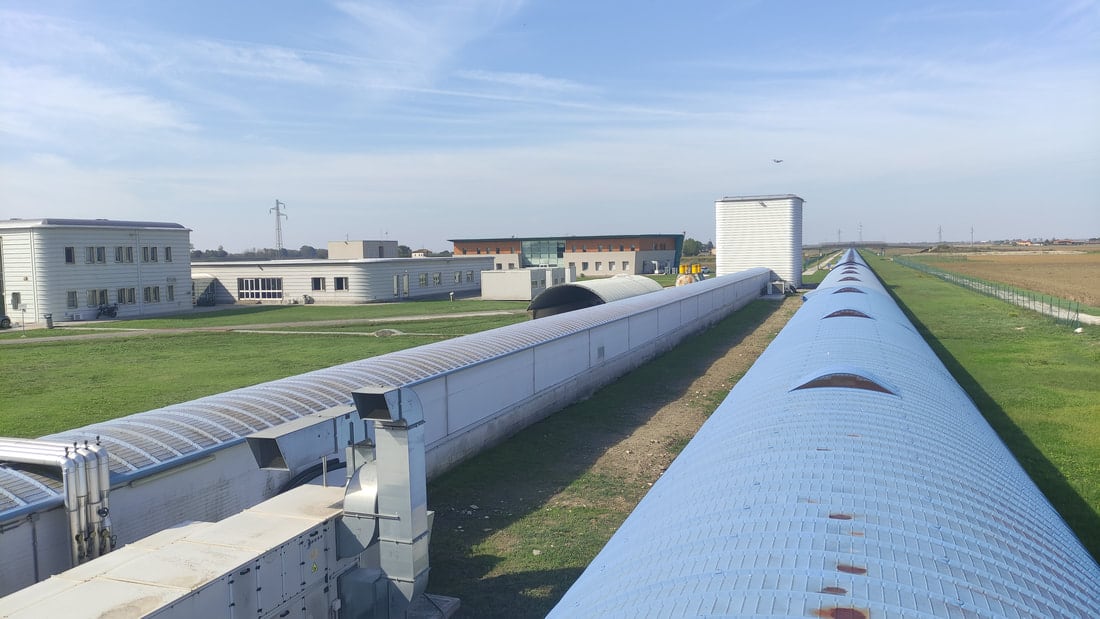
One of the 3 km arms of the Virgo gravitational-wave detector

Research area

Multi-messenger searches

Real-time alerts and coordinated follow-up observations connect neutrinos, gravitational waves and gamma rays to identify the sources of cosmic explosions.

Neutrinos, gravitational waves and gamma rays carry complementary information about the most violent events in the universe. Combining them requires real-time alerts and coordinated follow-up observations, which have been at the heart of my work since the first joint analyses of H.E.S.S. gamma-ray and ANTARES neutrino data. Keeping up with the growing number of alerts also needs new tools for scientists, which led to Astro-COLIBRI.

Real-time follow-up

H.E.S.S. · since 2016

Real-time multi-messenger alerts

After the first joint analyses of H.E.S.S. gamma-ray data with neutrinos from ANTARES and archival IceCube directions, the H.E.S.S. multi-messenger programme moved into the time domain in early 2016. We installed and commissioned an alert-reception system at the H.E.S.S. site and connected the data acquisition to the IceCube and ANTARES neutrino telescopes. Whenever a particularly interesting event is recorded, an alert is exchanged immediately; after a rapid, automatic analysis of the alert, the telescopes are pointed at the target without human intervention, avoiding unnecessary delays.

First results were presented at the AMON workshop 2016 and at the 35th International Cosmic Ray Conference in 2017 (arXiv:1708.00466). The full transients follow-up system, operational since 2016, is described in the paper below.
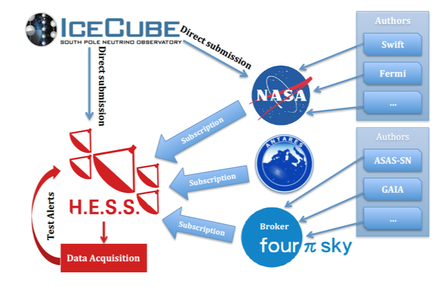
Schematic view of the H.E.S.S. system that receives alerts from other observatories and reacts to them automatically
The H.E.S.S. system receiving alerts from a wide variety of observatories and reacting to them automatically and in real time. Figure from C. Hoischen, Baikal workshop 2016.

Gravitational waves

GW170817 · August 2017

The first ground-based observations of a neutron-star merger

The first direct detection of gravitational waves by LIGO in 2015 opened a new window on the universe. H.E.S.S. joined the electromagnetic follow-up group of LIGO and Virgo, and because gravitational-wave localisations can span hundreds or even thousands of square degrees, we developed dedicated follow-up strategies, work led by my PhD student Monica Seglar-Arroyo (arXiv:1705.10138).

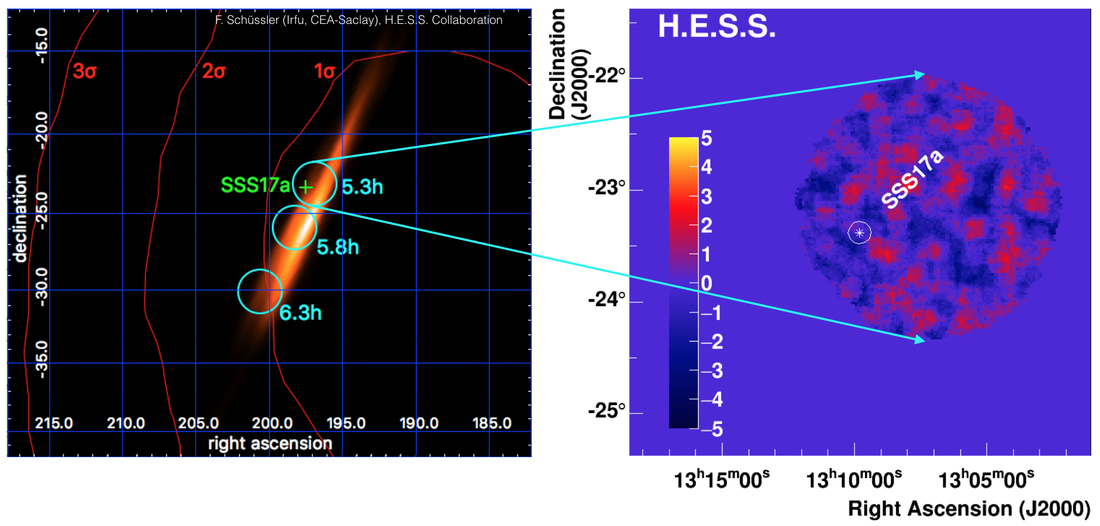
The preparation paid off in August 2017 with GW170817, the merger of two neutron stars, followed by the gamma-ray burst GRB 170817A and a kilonova. We triggered H.E.S.S. about five minutes after LIGO and Virgo published the localisation and obtained the first observations of the event by a ground-based pointing instrument; the first region observed contained the optical counterpart SSS17a. No very-high-energy emission was found, and the upper limits were the first to constrain non-thermal emission after a confirmed neutron-star merger. Combined with radio and X-ray data, the H.E.S.S. observations later helped probe the magnetic field in the merger's outflow.

H.E.S.S. pointing directions of the first night of follow-up observations over the GW170817 localisation map, and the significance map around the optical counterpart SSS17a

H.E.S.S. · O2 and O3

A rapid follow-up programme for gravitational waves

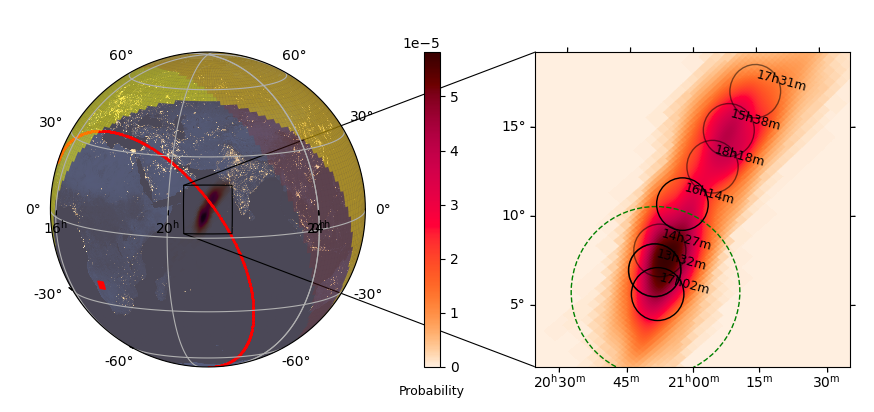
The scheduling algorithms have been continuously improved since. Led by my PhD student Halim Ashkar, a fully automated system was built into the H.E.S.S. data acquisition and transients system. With it, H.E.S.S. observed four binary black-hole mergers during the second and third observing runs of LIGO and Virgo: GW170814, GW190512_180714, GW190728_064510 and GW200224_222234. No very-high-energy signal was found, but the upper limits constrain very-high-energy emission from black-hole mergers for the first time.

H.E.S.S. coverage of the gravitational-wave event GW190728_064510, with the visible sky from Namibia and the telescope pointings over the localisation map
H.E.S.S. coverage of GW190728_064510. Left, the localisation projected on Earth at the start of the observations; right, the probability map with the fields of view of the individual H.E.S.S. pointings (black circles).

CTAO · tilepy

Preparing CTAO for gravitational-wave alerts

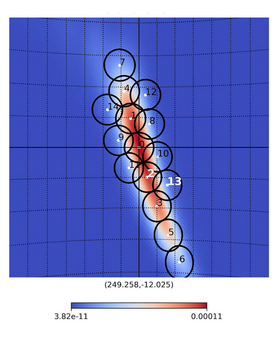
The same tools now prepare the observation programme of the Cherenkov Telescope Array Observatory. I co-led the CTAO consortium study of how CTAO can follow gravitational-wave alerts from binary neutron-star mergers. It uses tilepy, the open-source scheduler developed in my team, to plan observations covering the large localisation regions, and simulates the very-high-energy emission of a large population of synthetic merger–GRB associations to estimate how many joint detections to expect.

Gravitational-wave probability sky map covered by a numbered sequence of circular telescope pointings planned with tilepy

Neutrinos and gamma rays

ANTARES · H.E.S.S. · 2012

A first gamma-ray look at a neutrino hotspot

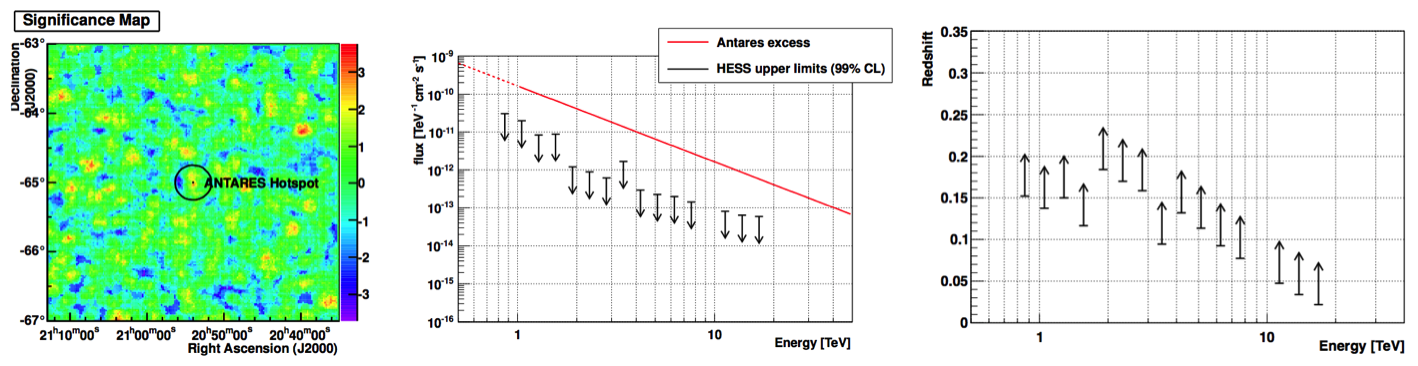
In 2012 an ANTARES search for point-like neutrino sources found a region with a mild excess of events, 2.2 σ above the background. Not very significant, but interesting enough for me to propose H.E.S.S. observations, which were taken in summer 2012. No gamma-ray emission was found, and I presented the analysis on behalf of H.E.S.S. at the 33rd ICRC (arXiv:1307.6074). The lesson stayed with me: even short gamma-ray observations, two hours in this case, can constrain hadronic scenarios suggested by neutrino telescopes. It led me to join H.E.S.S. to pursue these studies.

H.E.S.S. significance map of the region around the ANTARES neutrino excess, flux upper limits and derived distance limits
Left: H.E.S.S. significance map around the ANTARES neutrino excess. Middle: the gamma-ray upper limits rule out a source emitting neutrinos and gamma rays with equal luminosity. Right: lower limits on the distance of a potential source, taking absorption on the extragalactic background light into account.

IceCube · H.E.S.S. · 2014–2016

Following IceCube's astrophysical neutrinos

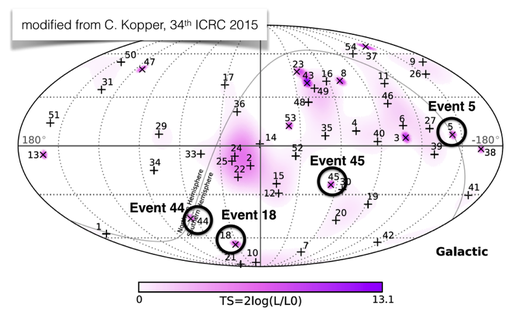
After IceCube discovered an astrophysical flux of high-energy neutrinos, I initiated the first multi-messenger programme within H.E.S.S. Over 2014 to 2016, H.E.S.S. observed several regions around the reconstructed neutrino directions, searching for a joint source of neutrinos and gamma rays, which would be strong evidence for a hadronic cosmic-ray accelerator. No strong gamma-ray emission was found. I reported the results at the 34th ICRC and the 6th Gamma-Ray Symposium.

Sky map of reconstructed directions of high-energy IceCube neutrinos with the regions observed by H.E.S.S.
Reconstructed directions of high-energy neutrinos observed by IceCube (from C. Kopper, ICRC 2015), several of which H.E.S.S. observed in 2014 and 2015.

TXS 0506+056 · September 2017

The first source of high-energy neutrinos?

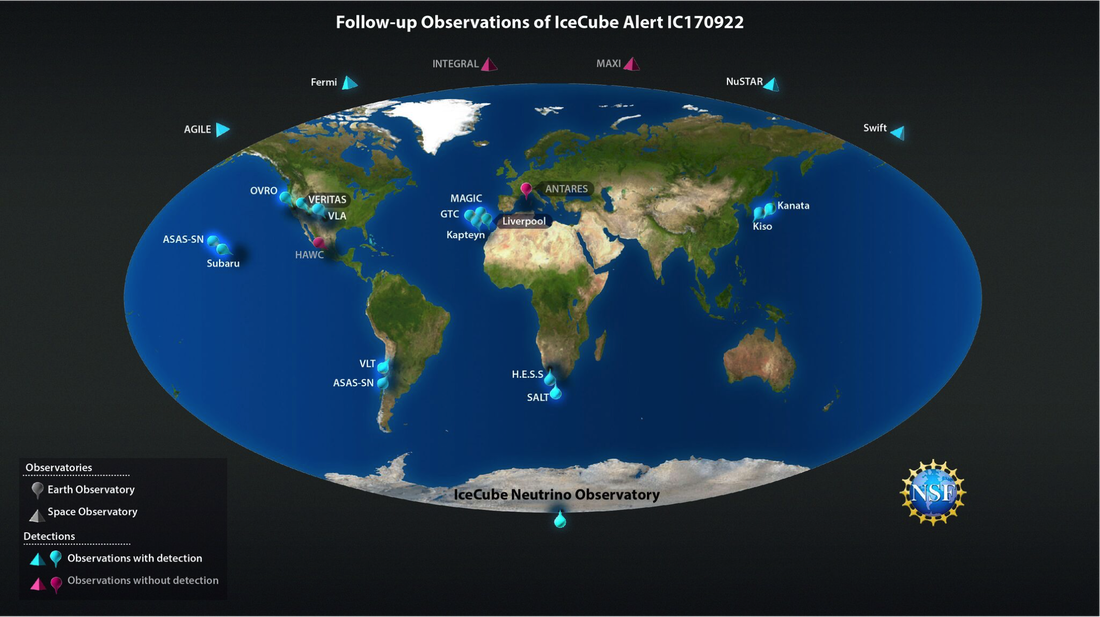
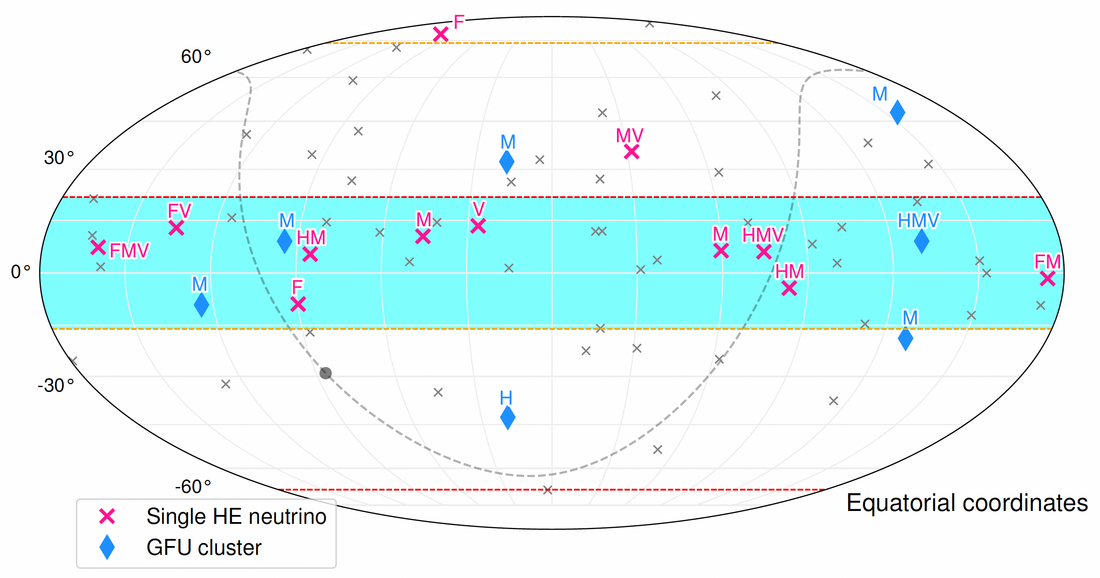
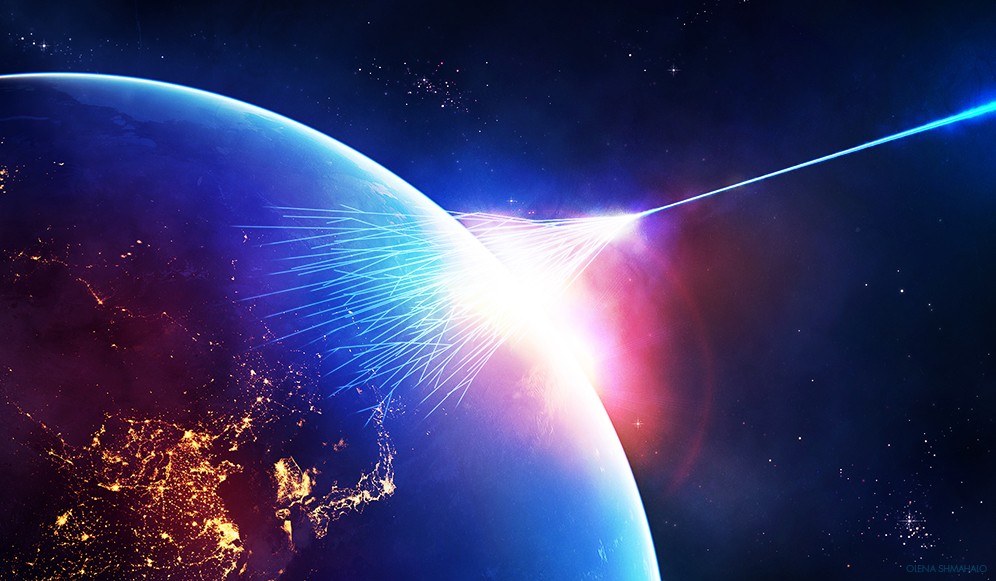
On 22 September 2017 IceCube detected a high-energy neutrino, IceCube-170922A, with an energy of about 290 TeV. Its direction was consistent with the known gamma-ray blazar TXS 0506+056, which was flaring. An extensive campaign followed, from radio to gamma rays, including the first detection of TXS 0506+056 at very high energies. A neutrino in coincidence with a flaring gamma-ray blazar suggests that blazars may be sources of high-energy neutrinos. The real-time neutrino follow-up has continued since; see Neutrino astronomy.

Illustration of the observatories that took part in the multi-messenger campaign on the neutrino IceCube-170922A and the blazar TXS 0506+056