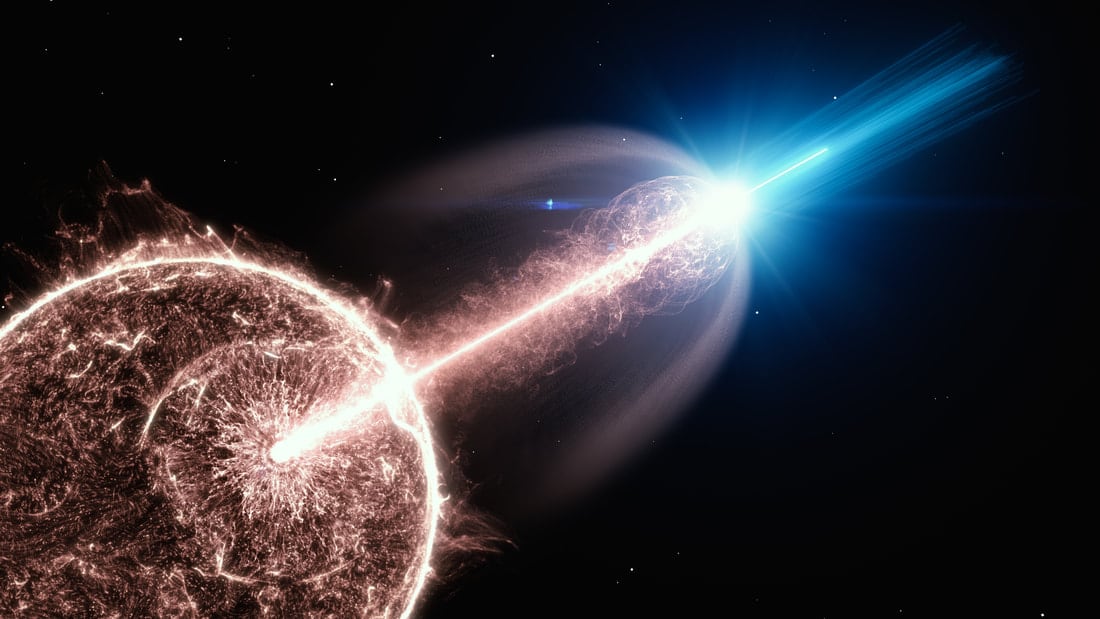
Artist's impression of a gamma-ray burst jet breaking out of a collapsing star

Research area

Gamma-ray bursts

Gamma-ray bursts are the brightest explosions in the universe. Discover how H.E.S.S. and CTAO search for their very-high-energy emission.

Gamma-ray bursts (GRBs) are the most violent explosions in the universe, and an obvious central part of every observation programme aiming to understand them. All current gamma-ray observatories have tried to detect their emission at very high energies over the last two decades. After many unsuccessful attempts, recent years have brought several breakthroughs, and I was lucky enough to lead the observation campaigns behind the first detections. Since 2019 I have led the transient programme of H.E.S.S., which includes the follow-up of gamma-ray bursts.

GRB 180720B · July 2018

The first detection at very high energies

On 20 July 2018 H.E.S.S. followed up a burst detected by Swift, Fermi and other satellites. About ten hours after the burst, two hours of data taken with the large 28 m H.E.S.S. II telescope revealed a new point-like source at the burst position: the first detection of very-high-energy gamma rays from a gamma-ray burst, deep in its afterglow. The result was published in Nature in November 2019, together with the MAGIC detection of GRB 190114C.
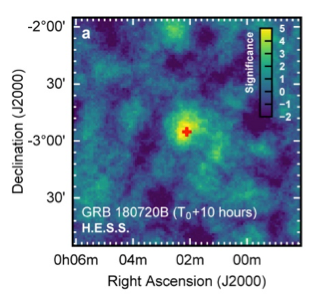
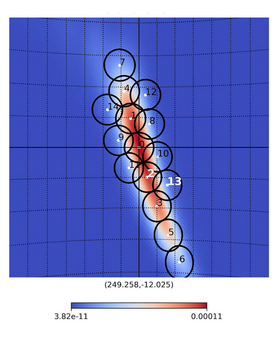
H.E.S.S. significance map of GRB 180720B 10 to 12 hours after the burst, with the optical position marked by a red cross

GRB 190829A · August 2019

Nearby, faint and long-lasting

After GRB 180720B proved that very-high-energy radiation exists in gamma-ray burst afterglows, the H.E.S.S. observations of GRB 190829A that I led brought more surprises. At z = 0.0785 it is one of the nearest bursts known. H.E.S.S. started observing about 4.5 hours after the burst and followed it for several nights. The emission turned out to be present in a low-luminosity burst too, it lasted for days, and the X-ray and TeV spectra look strikingly alike, which is hard to explain with current models.

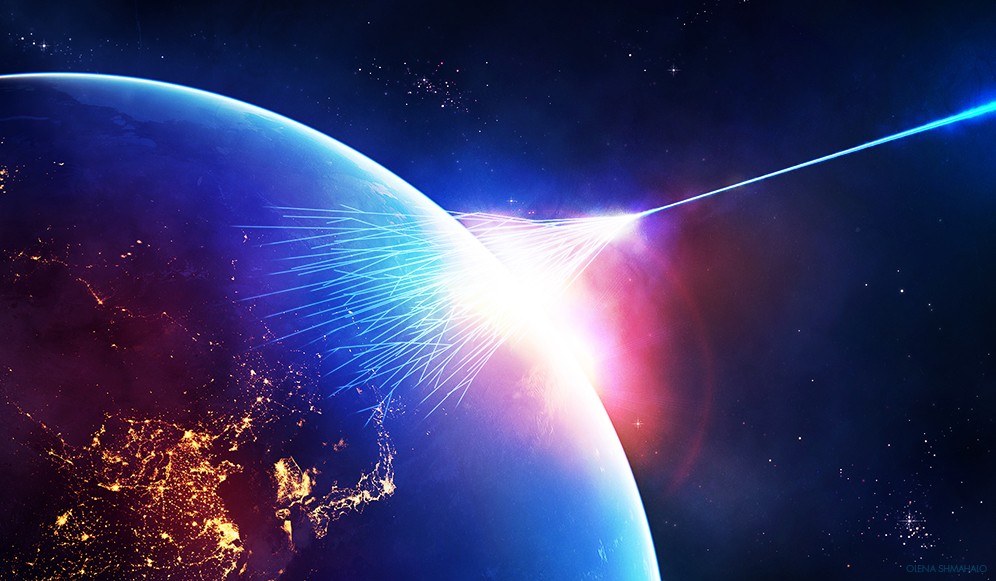
Artist's impression of a gamma-ray burst jet breaking out of a collapsing star

GRB 221009A · October 2022

The brightest burst of all time

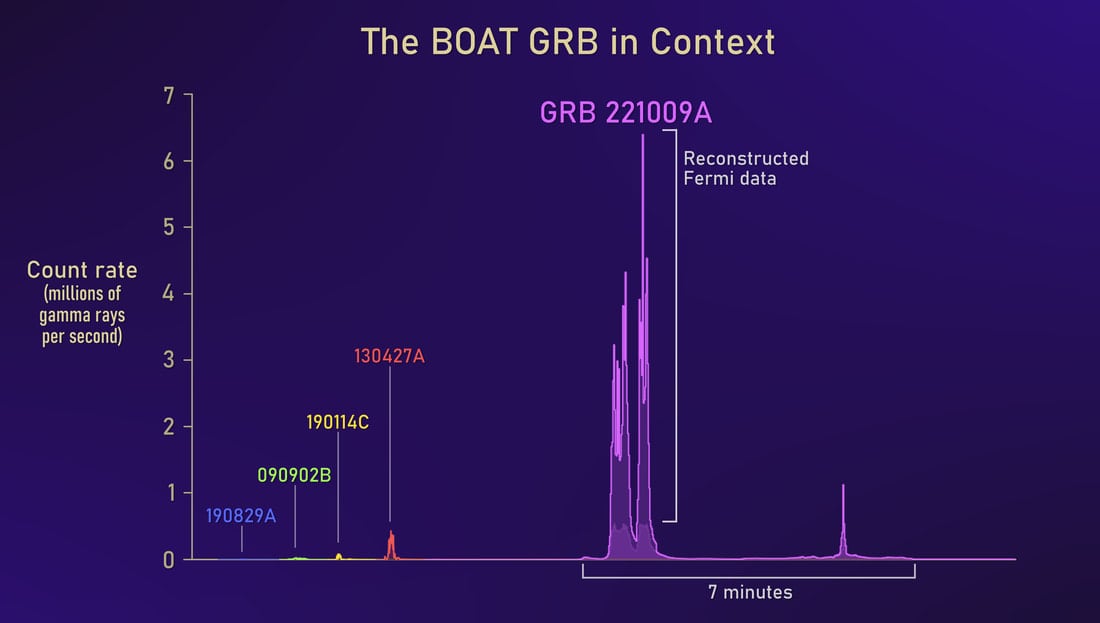
Radiation from the brightest gamma-ray burst ever recorded was seen by practically every X-ray detector. Bright moonlight meant two long days of waiting before H.E.S.S. could start its campaign, which then continued for more than a week. The data show no sign of very-high-energy photons from this monster burst, but the limits on the gamma-ray flux still guide the theoretical understanding of this exceptional event. Its radio afterglow was followed for 475 days; see Radio transients.

Chart comparing the prompt emission of GRB 221009A with five earlier record-holding long gamma-ray bursts

H.E.S.S. · 15 years

Fifteen years of gamma-ray bursts

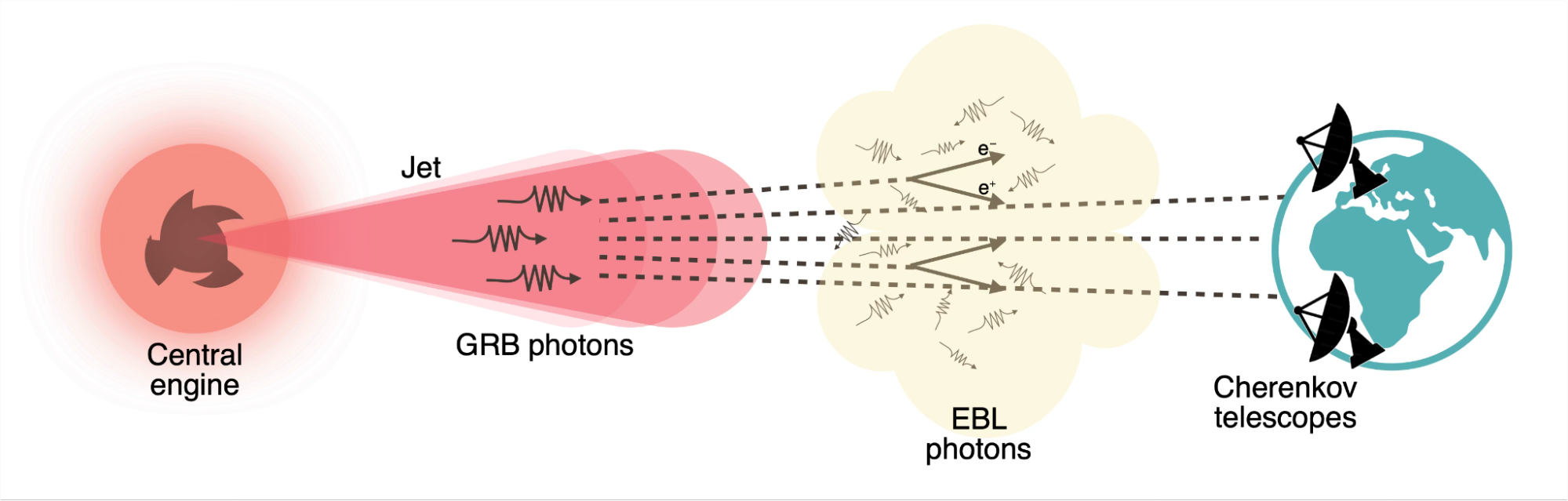
The second H.E.S.S. gamma-ray burst catalogue, published in 2026, is a full re-analysis of fifteen years of follow-up observations: more than 100 bursts observed at very high energies. The work was led by Mathieu de Bony, a MOTS postdoc at IRFU. Comparing the H.E.S.S. data with Fermi and Swift observations, it shows that bursts need to be both very bright and relatively nearby to be seen at very high energies, defines the horizon set by absorption on the extragalactic background light, and supports very-high-energy emission as a common feature of afterglows.

Diagram of a gamma-ray burst jet whose very-high-energy photons are partly absorbed by extragalactic background light before reaching Cherenkov telescopes on Earth