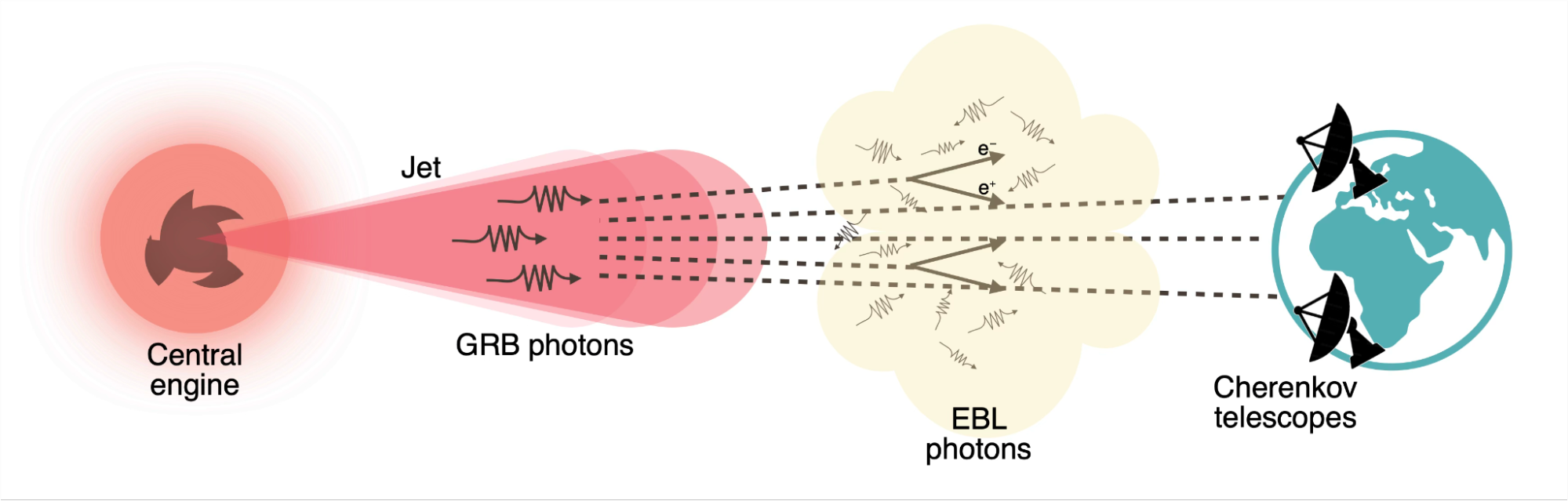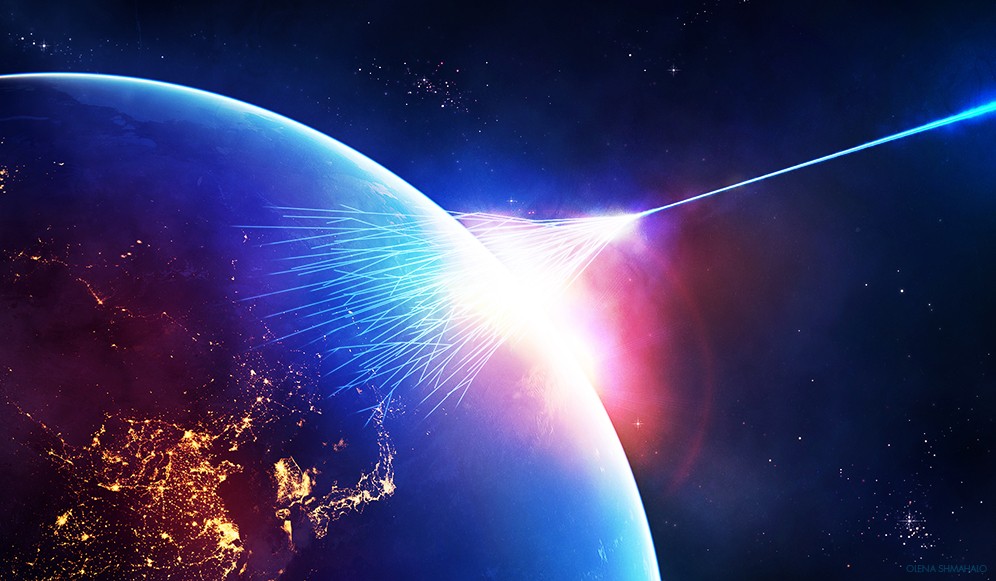
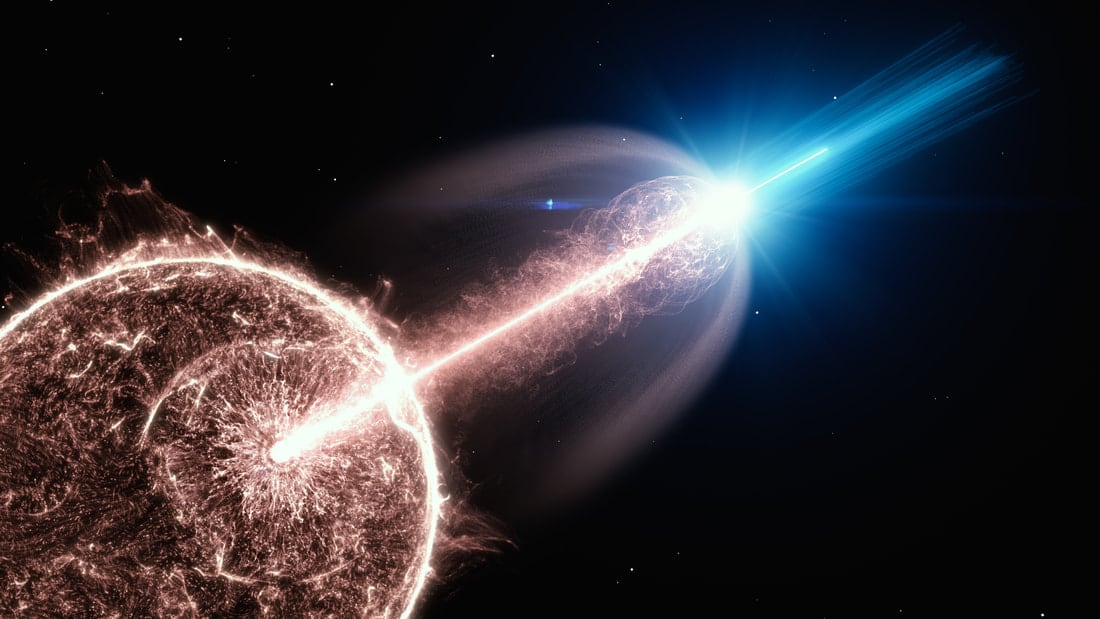
The H.E.S.S. (High Energy Stereoscopic System) collaboration has reached a major milestone in transient astrophysics with the publication of its first comprehensive Gamma-Ray Burst (GRB) catalog. Synthesizing over a decade and a half of observations, this landmark study provides a population-level analysis of more than 100 events observed at very-high-energy (VHE) scales.Led by Mathieu de Bony, a MOTS postdoc at IRFU, CEA Paris-Saclay, the research offers a definitive look at how ground-based Cherenkov telescopes detect the universe’s most violent explosions. By comparing H.E.S.S. data with satellite observations from Fermi and Swift, the study illuminates the physical conditions—specifically extreme brightness and relative proximity—required for a burst to be visible in the VHE band.
A key finding of the publication is the precise definition of the “cosmic horizon.” This boundary is created by Extragalactic Background Light (EBL), which absorbs distant gamma rays as they travel through space. The catalog confirms that while EBL limits how far we can see, VHE emission is likely a universal feature of GRB afterglows, providing a new roadmap for understanding particle acceleration in cosmic jets.
Further information: https://hess-experiment.eu/2026/04/HESS-SOM30804/
Publication: A. Acharyya et al. (H.E.S.S. Collaboration), 2026, “The second H.E.S.S. gamma-ray burst catalogue: 15 years of observations with the H.E.S.S. telescopes”, Astronomy & Astrophysics 707, A382.